
Country Roots Met California Fire: Linda Ronstadt and the Eagles Ignite a Defining 1974 Moment
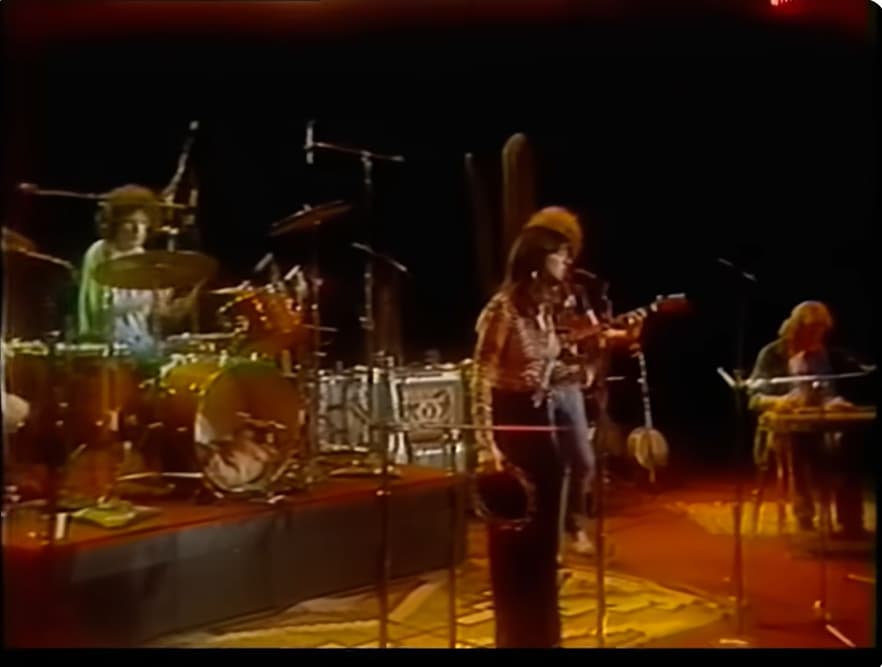
A rare 1974 performance of “Silver Threads and Golden Needles” brings together Linda Ronstadt and Eagles at a pivotal moment in the evolution of the California sound. Captured during the Don Kirshner’s Rock Concert era, this collaboration offers more than nostalgia. It documents a creative intersection where country tradition, rock ambition, and vocal precision converged with remarkable clarity.
At the time, Ronstadt was already emerging as one of the most commanding voices in American music. Her interpretation of “Silver Threads and Golden Needles,” a song rooted in earlier country traditions, transforms the material into something sharper and more modern. Rather than leaning into sentimentality, she delivers the lyrics with defiance and control, reframing the song as a statement of independence rather than heartbreak.
Behind her stands a group of musicians who would soon define an entire decade. Members of the Eagles, including Glenn Frey and Don Henley, had already built their early careers as part of Ronstadt’s touring band. This performance reflects that shared history. The chemistry is not manufactured for television. It is the product of years spent refining a sound that blended country storytelling with rock structure and harmony driven arrangements.
What makes this clip particularly compelling is its sense of immediacy. There is no excess production, no elaborate staging, and no attempt to overshadow the music itself. The arrangement is tight yet unforced. The harmonies arrive with precision but retain a natural warmth. Ronstadt remains the focal point, yet the Eagles provide a foundation that elevates every phrase without competing for attention.
Viewed through a historical lens, the performance captures a transitional phase. The Eagles were on the verge of global recognition, while Ronstadt was moving toward the commercial peak that would define the mid to late 1970s. In this moment, however, they exist as collaborators rather than icons. That balance gives the recording its enduring appeal.
The song itself carries an added layer of meaning in this context. Its themes of resilience and self worth mirror Ronstadt’s own artistic trajectory. Surrounded by musicians who would soon become legends in their own right, she stands firmly at the center, shaping the direction of a sound that would come to dominate American radio.
This performance is more than a television appearance. It is a document of origin, a meeting point of talent before fame reshaped the narrative. For viewers today, it offers a rare opportunity to witness not just a song, but the formation of a musical legacy that continues to resonate across generations.