
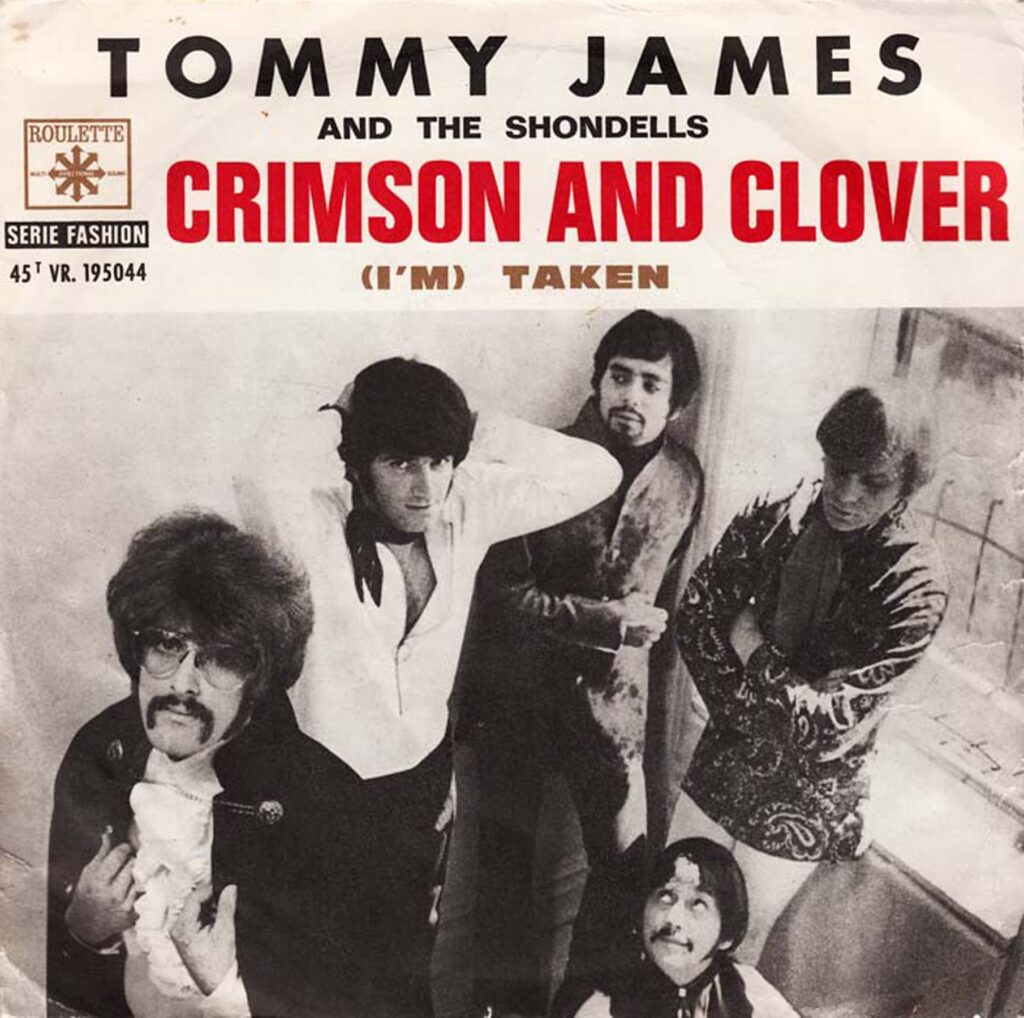
“Crimson and Clover”: A Psychedelic Tapestry of Adolescent Longing and Ethereal Connection.
There are moments in music when innovation meets intuition, when a band reaches beyond the expected to create something truly groundbreaking, yet utterly timeless. For those of us who recall the vibrant, often experimental, soundscape of the late 1960s, Tommy James & the Shondells are forever etched into our memories, not just for their catchy pop hits, but for their audacious foray into psychedelic rock with the mesmerizing “Crimson and Clover.” Released in November 1968, this song wasn’t just a hit; it was an atmospheric journey, a hazy dream woven with distinctive vocal effects and a pulsating beat that captured the very essence of youthful yearning and the intoxicating allure of a nascent love. For older readers, it instantly transports one back to an era of cultural transformation, of exploring new sonic frontiers, and the intoxicating sensation of first love.
Upon its release as a single in November 1968, “Crimson and Clover” quickly ascended the charts, becoming a monumental success for Tommy James & the Shondells. It soared to the coveted number 1 position on the Billboard Hot 100 chart in the United States in February 1969, where it held its reign for two consecutive weeks. This marked a significant achievement, cementing the band’s status as pop innovators capable of crafting both accessible and artistically adventurous material. The single was also a global hit, reaching number 1 in Canada, New Zealand, and Switzerland, and performing exceptionally well across Europe. The song was the title track of their seventh studio album, Crimson and Clover, released in December 1968, which also enjoyed considerable success, peaking at number 53 on the Billboard 200. For many of us, hearing those iconic tremolo-laden guitar chords float through the air was an immediate signal to tune in, to turn up the volume, and to get lost in its enchanting spell.
The story behind “Crimson and Clover” is as fascinating as its sound, marked by serendipity and a bold willingness to experiment in the studio. The song was conceived by Tommy James and his bandmate Peter Lucia Jr., the group’s drummer. The title itself came to James almost instinctively; he couldn’t get the words “crimson” (his favorite color) and “clover” (his favorite flower) out of his head. He believed these two words had a certain lyrical quality and decided to write a song around them, even before knowing what the song would be about. This abstract approach to songwriting allowed the music to shape the narrative, rather than the other way around.
What truly set “Crimson and Clover” apart was its innovative production, a testament to the band’s creative daring. Recorded on a then-cutting-edge 16-track machine, the song featured a distinctive tremolo effect on the guitar, creating a wavering, almost dreamlike sound. The most memorable element, however, was the vocal effect on James’s voice during the instrumental break and the outro: a process called “vari-speeding” or “tape phasing,” where the tape speed was manually manipulated to create a warbling, almost alien sound. This unique, psychedelic vocal effect, particularly the repeated “ah-ah-ah-ah-ah,” became instantly recognizable and deeply influential, pushing the boundaries of pop production at the time. This daring experimentation was a conscious effort by James to evolve the band’s sound beyond pure bubblegum pop.
The meaning of “Crimson and Clover” is an atmospheric exploration of young love and an almost ethereal connection. The lyrics are relatively sparse, allowing the evocative music and the iconic vocal effect to convey much of the sentiment. It speaks of a longing gaze, a moment of profound recognition and mutual attraction: “Ah, now I don’t hardly know her / But I think I could love her / Crimson and clover / Over and over.” It’s about being utterly captivated by someone, to the point where time seems to stand still and the world shrinks to just the two of you. The psychedelic elements enhance this feeling of being entranced, as if falling into a blissful, dreamlike state. For older readers, this song isn’t just a flashback to bell-bottoms and tie-dye; it’s a visceral memory of those first exhilarating surges of infatuation, the feeling of a world suddenly bursting into new colors and sounds because of another person. It reminds us of a time when everything felt possible, and love, even in its nascent stages, held an intoxicating, almost magical, power. “Crimson and Clover” remains a brilliant example of how a willingness to experiment can create enduring art, leaving us forever enchanted by its mysterious, beautiful embrace.