
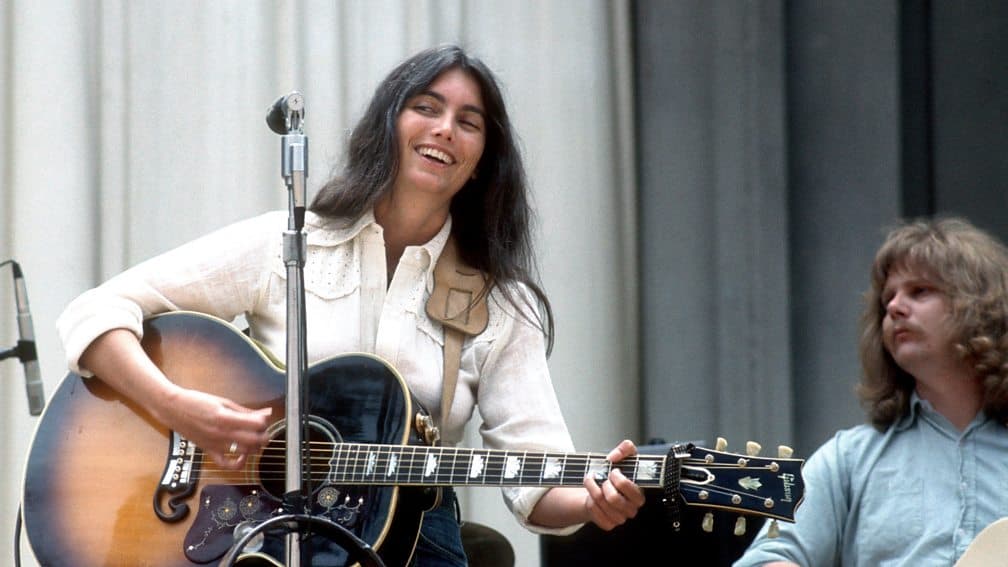
A Free-Spirited Anthem that Captured the Roaming Heart of a New Era in Country Music.
There are certain songs that, upon first listen, feel less like a composition and more like an open road—a gentle, rolling melody that invites you on a journey. For a generation of listeners, Emmylou Harris’s 1975 debut on a major label, “Pieces of the Sky,” was just that journey, and its opening track, “Bluebird Wine,” was the perfect invitation. This song, with its easygoing tempo and the unmistakable, crystalline purity of Harris’s voice, didn’t just introduce an artist; it introduced a new sound, a new sensibility, and a new kind of country music that was both traditional and defiantly modern. While “Bluebird Wine” was never released as a single and therefore has no chart position of its own, the album it opened, “Pieces of the Sky,” was a landmark in itself, climbing to number 7 on the Billboard Country Albums chart and setting the stage for a legendary career. It was the album’s first single, “If I Could Only Win Your Love,” that became a top-five country hit, but it was “Bluebird Wine” that truly established the album’s free-spirited, cosmopolitan country soul.
The story behind this song is as fascinating as its sound, revealing the collaborative genius that defined Harris’s early career. The track was not an original, but a cover of a song written by the brilliant and elusive Rodney Crowell, a young songwriter who was just beginning to make his mark. Crowell and Harris’s paths crossed through their mutual association with Gram Parsons, a crucial figure whose influence is evident in every note of “Pieces of the Sky.” Harris’s decision to open her pivotal debut album with a song by an unknown songwriter was a bold statement, a testament to her impeccable taste and her instinct for spotting raw, authentic talent. She wasn’t just a singer; she was a curator of great music, and by championing Crowell, she not only launched his career but also solidified her own reputation as a true artist with an eye for the future.
The song’s meaning is an ode to restless hearts and the yearning for escape. The lyrics paint a picture of a soul longing to break free from the constraints of a failing love and a stagnant life. “Bluebird wine” itself is a poetic metaphor, a concoction that promises to carry the singer away from a world of sorrow and into a place of freedom and renewal. It speaks to a deep, universal desire to leave behind what is broken and to seek out a new beginning. For many who came of age in the 1970s, a decade marked by both social upheaval and a search for personal meaning, the song’s theme of hitting the road and finding oneself resonated deeply. It was a song for anyone who ever packed a bag, bought a one-way ticket, and dared to hope for a better tomorrow.
Revisiting “Bluebird Wine” today, it’s impossible not to feel a surge of nostalgia. Its rolling rhythm and the effortless grace of Harris’s vocals evoke memories of driving with the windows down, the wind in our hair, and a sense that anything was possible. It’s a song that captures the bittersweet essence of leaving home and the exhilarating promise of the unknown. More than a simple tune, it is a marker of a moment in time—a time when country music was expanding its borders, embracing a more lyrical, introspective, and beautifully melancholic sound. It’s a reminder of a young Emmylou Harris at the dawn of her journey, a troubadour with a guitar and a voice, ready to change the world, one perfect song at a time.
 Oldies Songs