
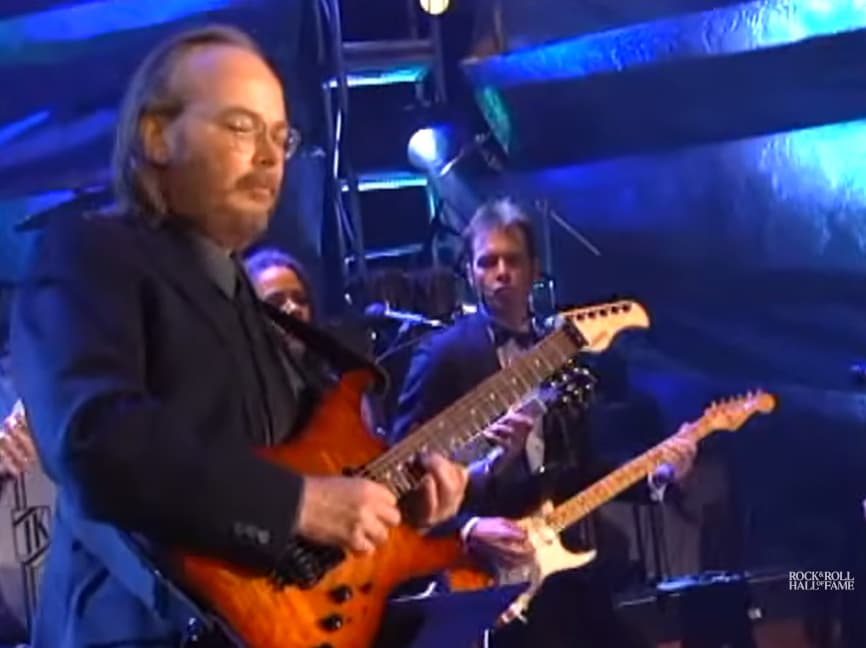
A Sharp Edge in a Polished World: Steely Dan’s “Black Friday” at the Rock and Roll Hall of Fame, 2001
When Steely Dan took the stage at the Rock and Roll Hall of Fame Induction Ceremony in 2001, expectations were naturally high. Known for their precision, irony, and immaculate studio craft, the band rarely leaned on spectacle. Their performance of “Black Friday” that night reflected exactly that sensibility. It was tight, controlled, and quietly confident, a reminder that Steely Dan’s strength has always come from intelligence and intention rather than volume alone.
“Black Friday” has long stood as one of the band’s most cutting songs. Beneath its smooth surface lies a sharp narrative of escape, paranoia, and social collapse. Performed in the context of an induction ceremony, the song took on a new dimension. This was not a rebellious statement from outsiders, but a self aware moment from artists being formally welcomed into the institution they once viewed with skepticism. That tension gave the performance its subtle edge.
On stage, the band delivered the song with remarkable discipline. The groove was exact, the rhythm section locked in, and the arrangement faithful without feeling mechanical. Every note felt considered. Rather than exaggerating the song’s darker themes, Steely Dan let the music speak through nuance. The cool precision of the performance mirrored the song’s emotional distance, creating a mood that was both engaging and unsettling.
What made this appearance especially compelling was the sense of control. By 2001, Steely Dan had already proven their influence across decades of popular music. There was no urgency to impress. Instead, the band appeared relaxed, fully aware of their place in the larger story of rock. That confidence allowed “Black Friday” to land with greater impact. The song did not shout. It observed.
The Rock and Roll Hall of Fame setting added irony to the moment. “Black Friday” is a song about running from chaos, yet it was being performed on a stage meant to celebrate permanence and legacy. Steely Dan did not attempt to soften that contrast. If anything, they leaned into it, allowing the song’s uneasy atmosphere to exist unchanged. The result was a performance that felt honest rather than ceremonial.
Vocally, the delivery remained detached, almost conversational. That restraint has always been central to Steely Dan’s appeal. Emotion is present, but it is filtered through wit and distance. In this live setting, that approach translated seamlessly. The audience was invited to listen closely, to catch the details rather than react to obvious cues.
This 2001 performance matters because it captured Steely Dan being exactly who they always were, even at a moment designed to honor and formalize their legacy. There was no grand gesture, no attempt to redefine themselves for the occasion. “Black Friday” was played as written, sharp and unsentimental.
In doing so, Steely Dan reminded everyone that longevity does not require compromise. Precision, intelligence, and restraint can be just as powerful on a celebratory stage as they are in the studio. Their Rock and Roll Hall of Fame performance stands as a quiet affirmation that great music does not need to change its character to earn recognition.