
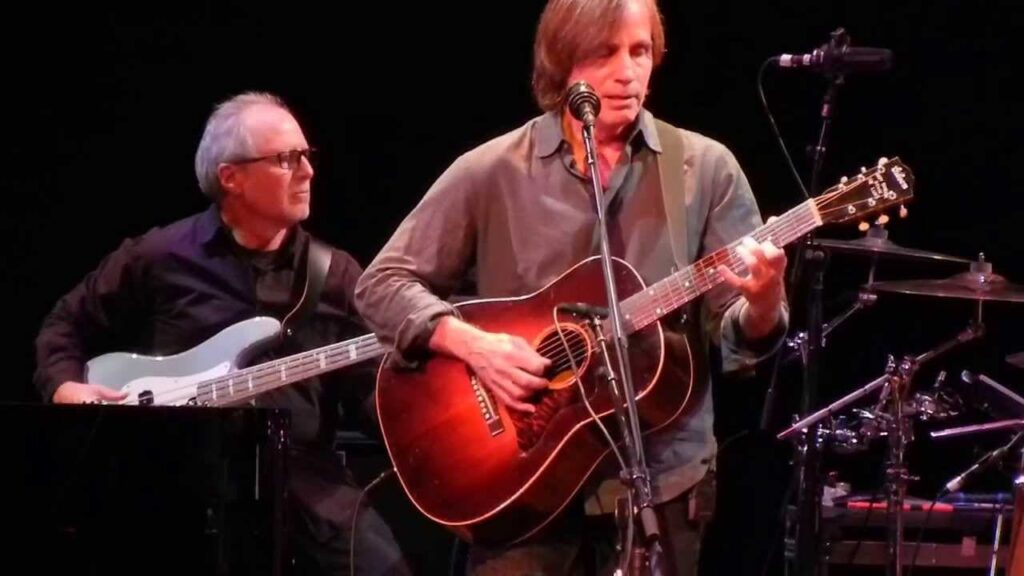
A Heartfelt, Bittersweet Return to the Dawn of Youthful Dreams, Mourning the Elusive Innocence of the Past.
By 1996, Jackson Browne was already a living legend, the quintessential California singer-songwriter whose body of work served as a fragile, poetic chronicle of a generation’s hopes, heartbreaks, and political awakenings. His album, Looking East, arrived not with the earth-shaking commercial force of his 1970s triumphs, but with the quiet authority of an artist deep into his career, still searching for truth and meaning. The album reached a respectable number 36 on the Billboard 200, a testament to his enduring following. Within its reflective tracklist was a song that wasn’t a charting single, but rather a profoundly moving, highly autobiographical piece of musical theatre. That song was “The Barricades of Heaven.” Its power lies not in commercial success, but in its ability to transport the listener back to the dawn of a golden, fleeting era, capturing the powerful, yet tragic, drama of memory itself.
The story of “The Barricades of Heaven” is Jackson Browne’s own dramatic journey back in time. By the mid-1990s, he had witnessed the full arc of the rock and roll dream—the idealism, the fame, the inevitable disillusionment, and personal tragedy. This song is a deliberate pause, a beautifully detailed return to the Southern California folk scene of the mid-1960s, before fame and complexity set in. He sings of his early days, living in a cheap apartment, playing guitar and writing with The Nitty Gritty Dirt Band, and feeling the endless, exhilarating possibility of youth. It is a dramatic, cinematic recreation of those moments of pure artistic innocence, where success felt inevitable and life’s complexities had yet to intrude. The presence of his old compatriots, David Crosby and Graham Nash, lending their signature, soaring harmonies to the track, reinforces this sense of brotherhood and shared history, giving the song a poignant, nostalgic depth that only decades of shared experience can forge.
The meaning of the song is rooted in the bittersweet tragedy of time passing. The titular “barricades of heaven” is a perfect, poetic metaphor for the elusive nature of youth and innocence. They represent the dreams—the unattainable, utopian ideals—that we chase as young artists, believing that simple passion and talent can conquer all. Browne sings of seeing those barricades, those dreams, in the eyes of the young, but also of the mature artist’s realization that those impossible heavens are guarded, and that the simplicity of the past is gone forever. The song is a lengthy, introspective monologue, a conversation with a younger self that is full of tenderness, wistful regret, and profound gratitude for the people who shaped his journey.
Musically, the song is the perfect vehicle for this deeply emotional drama. The gentle acoustic intro, the driving, yet wistful, rhythm, and the warm, layered harmonies are full of a tender melancholy. It’s not a mournful sound, but a reflective one, a beautiful blend of joy in the memory and sadness in the finality of time. For older listeners, “The Barricades of Heaven” is a powerful, nostalgic mirror, reminding us all of our own “barricades of heaven”—the beautiful, impossible dreams of our youth that were so vividly clear and remain forever locked just beyond our reach. It stands as a timeless, deeply emotional, and profoundly dramatic piece of musical storytelling from a master of the form.