
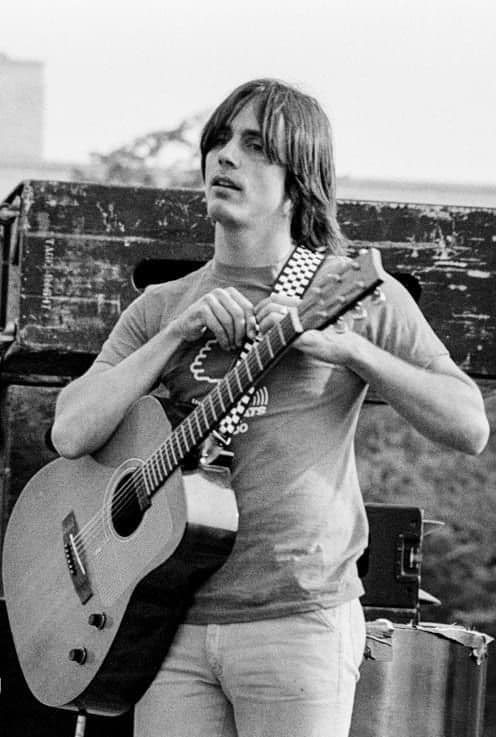
A Joyous and Defiant Outburst of Rock and Roll Energy, Celebrating the Liberating Chaos of Unconventional Friendship.
The year 1973 found Jackson Browne cemented in the public consciousness as the contemplative bard of the Southern California singer-songwriter movement. His music was the soundtrack to a generation’s quiet introspection, defined by honesty and melancholic grace. His second album, For Everyman, was an exercise in deepening that emotional honesty, reaching a respectable number 43 on the Billboard 200. Yet, amidst its landscape of beautifully somber songs about disillusionment and existential yearning, there was a shocking, joyous sonic intrusion that stood as a dramatic, rebellious anomaly. That song was “Red Neck Friend.” It was released as a single, yet notably failed to chart significantly, proving it was perhaps too wild, too defiant, and too untamed for the mainstream radio of the era. Its true power lies in the visceral, dramatic contrast it offered to Browne’s established artistic persona.
The story behind “Red Neck Friend” is one of artistic duality and a necessary break from character. After the profound pressure of his hugely successful debut, Browne needed an emotional release. This song is a full-throttle rock and roll monologue, a joyous ode to the kind of free-spirited, impulsively energetic friend who lives entirely outside the careful, cerebral confines of the narrator’s life. The lyrics are a vibrant, humorous portrait of reckless freedom and chaotic adventure—a celebration of the friend who pulls you out of your own deep thought and thrusts you headlong into the moment. The drama lies in the sheer unexpectedness of the track: the sensitive poet strapping on a distorted guitar and enthusiastically embracing a rough-and-tumble lifestyle he usually only observes from a reserved distance. It’s a musical liberation, a defiant shout against the very expectations he had created for himself.
The meaning of the song is rooted in the essential, corrective power of friendship: the chaotic energy of others can be the perfect antidote to one’s own over-introspection. It’s about embracing the impulsive side of life, finding salvation in the kind of reckless abandon that only a true, untamed friend can inspire. Musically, the song is a thunderous hard-rock romp, a complete stylistic shift for the artist. The aggressive, driving rhythm is utterly compelling, propelled by the muscular rhythm section and amplified by the blistering, distorted guitar work of Lowell George of Little Feat. And in a piece of trivia that adds a layer of dramatic star power, the robust backing vocals were provided by none other than Elton John. This track isn’t a ballad; it’s a musical adrenaline shot, a defiant roar of laughter that makes the listener feel the liberating relief of setting emotional complexity aside for a few minutes of pure, glorious noise.
For those of us who have followed the long, reflective road of Jackson Browne’s career, “Red Neck Friend” is a truly nostalgic and unforgettable sonic outlier. It’s a testament to the fact that even the most introverted artists need a moment to be loud, free, and completely unpredictable. The song stands as a magnificent, emotionally resonant piece of musical drama, a joyful snapshot of the collaborative, boundary-less spirit of the 1970s L.A. music scene, and a timeless reminder to stop thinking and just let the wild, joyous energy of life take over.