
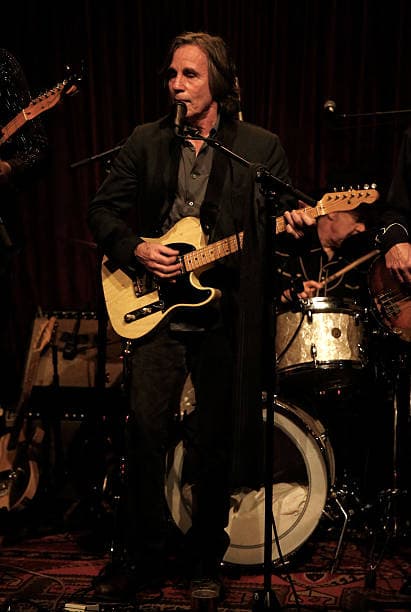
This Epic, Late-Career Ballad is a Bracingly Honest Testament to the Hard-Won Endurance of a Long-Term Love, Acknowledging Both the Sacrifice and the Deep, Unshakeable Reward.
By the year 2014, Jackson Browne was long past the era of easy Top 40 singles, but he had solidified his stature as the quintessential troubadour of the American soul—a man whose songs were not just hits, but chapters in the collective autobiography of a generation. His fourteenth studio album, Standing in the Breach, was a late-career masterpiece, a powerful meditation on both political activism and personal commitment. The album itself, released in October 2014 on his own Inside Recordings label, proved that his voice still resonated deeply with seasoned listeners, charting at No. 15 on the US Billboard 200 and reaching No. 31 on the UK Albums Chart.
Within that collection of bracing, reflective tracks lies the nearly seven-minute opus, “Yeah Yeah.” Unlike his classic radio anthems, this song was not released as a commercial single and therefore claims no single chart position. Its power is drawn from a different well entirely: the raw, unflinching honesty of a man taking stock of a decades-long relationship. It is a song born not of the thrilling, tumultuous heartbreak of youth that defined The Pretender or Late for the Sky, but of the quiet, complex drama of enduring love.
The story behind “Yeah Yeah” is the emotional summation of that enduring love. The track is set up as a dialogue, or perhaps a fierce internal monologue, where the narrator—clearly Browne’s own weathered persona—is directly addressing his long-time partner. It’s an intensely vulnerable moment where he lays out the messy ledger of their history. The narrator acknowledges his own failings and wanderlust, the times his gaze was “down the road / Staring at the wreckage of a lifetime strewn along the track.” He wrestles with the monumental sacrifice his partner made: “You followed me away from your home / And we’re out here in this world on our own.” The narrative drama builds not from a threat of separation, but from the breathtaking realization of her constancy.
The core meaning is a celebration of commitment over infatuation, of perseverance over passion’s fleeting flame. It’s a powerful confession that the truest love is not found in the initial spark, but in the unwavering decision to stay—even when it’s not easy, even when it feels “crazy.” Browne’s lyricism here is magnificent, moving away from simple romantic poetry to tackle the deeper questions of mutual investment: “‘Cause you paid for the love that we’ve got, you paid / And you made for the heart when we fought and you stayed.” He asks the central, dramatic question of the song: “Was it strength or your pride that sent you back inside / For the love that you paid for / Or was it for the love that we’ve made.”
For older readers who have navigated the deep currents and hidden shoals of decades-long relationships, this song is a mirror. It stirs deep nostalgia for the moments we almost lost it all, followed by the quiet, profound gratitude for the partner who anchored us. “Yeah Yeah” is the sound of a man recognizing that his grand visions and personal wreckage were only survived because of the unwavering heart beside him. It is a testament to a truth often overlooked in popular music: that the most romantic gesture is simply betting “all I had / That you’d go on making me glad / That I found your love in this world / After times were so bad.” It is a mature, deeply moving affirmation that the drama of a shared life is ultimately about choosing to remain, over and over again, saying “Yeah, yeah.”