
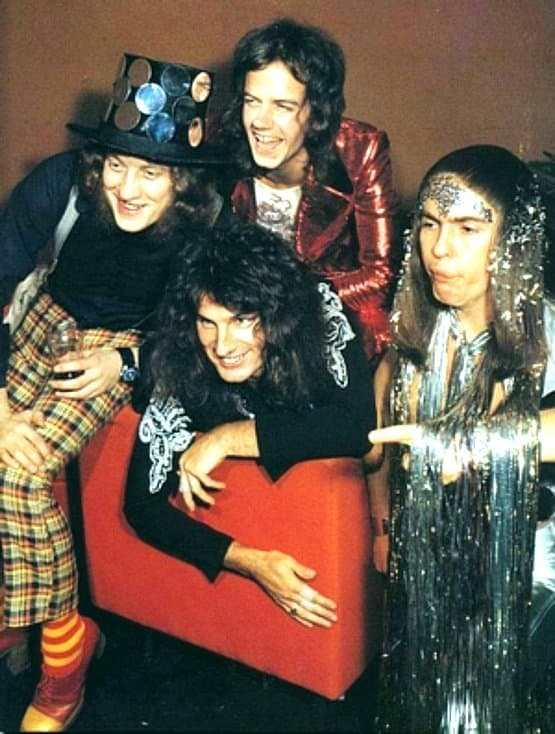
The Unlikely Ballad of a Road Warrior: A Dramatic, Enduring Plea for Comfort Penned Amidst the Glam Rock Frenzy.
The year 1972 was the year that Glam Rock truly exploded, and no band defined the joyous, deafening roar of working-class rebellion quite like Slade. Famous for their towering stack heels, outlandish costumes, and deliberately misspelled anthems, the Wolverhampton lads were relentless hit-makers. Yet, nestled among the crowd-baiting favorites on their essential 1972 live album, Slade Alive!, sits a dramatic, unexpected piece of vulnerability: a cover of the folk-rock ballad “Darling Be Home Soon.” This acoustic-driven track is a fascinating anomaly, a rare glimpse of the soulful heart beating beneath the band’s glittering, hard-rocking exterior.
Key Information: “Darling Be Home Soon” is a cover of a song originally written and recorded by The Lovin’ Spoonful’s John Sebastian for the soundtrack of the 1967 film You’re a Big Boy Now. Slade’s version is an album cut featured on the 1972 live album Slade Alive!, which was recorded at The Command Theatre Studio, London, in 1971. The album was a gargantuan success, becoming a critical document of their power, soaring to No. 2 on the UK Albums Chart and peaking at No. 151 on the US Billboard 200. Crucially, as a deep cut on a live album, “Darling Be Home Soon” was never released as a commercial single and therefore holds no individual chart position, existing instead as a beloved moment of quiet drama for devoted fans.
The story behind this song is steeped in the hard reality of the early 1970s touring grind. Slade, led by the charismatic Noddy Holder and his powerhouse vocals, were rock-and-roll gladiators, constantly on the road, whipping up a frenzy in every town they played. But beneath the celebratory “Coz I Luv You” and “Get Down and Get With It” anthems lay the profound loneliness of separation. “Darling Be Home Soon” provided a perfect vehicle for the band to acknowledge the emotional toll of that life. It was a conscious decision by the band to inject a moment of raw, unamplified emotion into the otherwise raucous live show, giving both the audience and themselves a breather. In this acoustic setting, the dramatic force of Noddy Holder’s voice—stripped of distortion and echo—shines through with a surprising, tender sincerity.
The meaning of the track, therefore, transcends the original folk-pop of Sebastian. In Slade’s hands, it becomes a plea from the road warrior—a working-class hero separated from his anchor. The lyrics are a simple, desperate bargaining for comfort: “Come on, little darling, be home soon / Come on, little darling, be home soon / ‘Cause I ain’t seen nothin’ that looks like home.” It speaks directly to the dramatic contradiction of the rock lifestyle: the cheers of thousands at night are no substitute for the quiet presence of one person in the morning. It’s a powerful, raw expression of the human need for connection when facing isolation.
For older, well-informed readers, this song is a potent wave of nostalgia, reminding us that even the most outrageously dressed, ear-splittingly loud bands possessed a vulnerable core. It is the dramatic, tear-stained letter home slipped beneath the door after a night of chaos. “Darling Be Home Soon” remains a timeless testament to the power of a simple, beautiful melody to cut through the noise and reveal the raw, honest truth of the human heart, making it an essential and deeply emotional part of the Slade catalogue.