
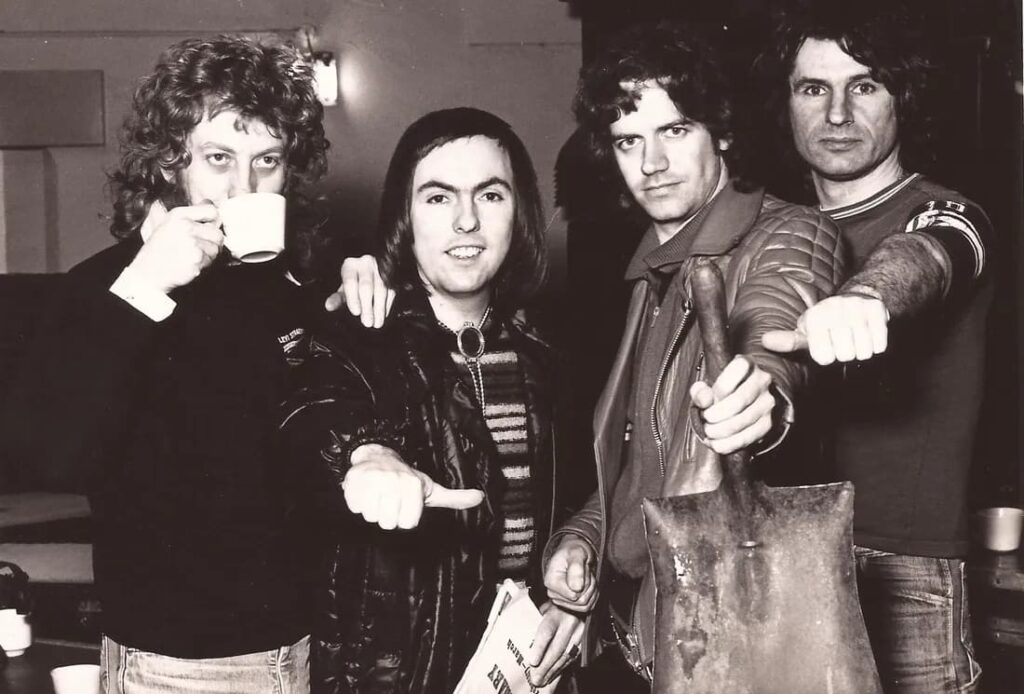
A darkly charged burst of restless energy that captures Slade’s hunger to rise again in a shifting rock landscape
When Slade released “Night Starvation” in 1981 on their comeback album We’ll Bring the House Down, the band was emerging from a difficult period and rapidly reclaiming momentum in the British rock scene. The album reached the UK Top 30, signaling a renewed surge of interest in the group, and “Night Starvation” stood out as one of its most ferocious statements of intent. The track did not chart as a standalone single, yet it became a crucial part of the album’s atmosphere, reinforcing Slade’s revival as they reasserted their identity in the post punk, early new wave moment of the era.
“Night Starvation” hits with a gritty urgency from the first beat. The guitars grind forward with a raw, almost metallic edge, and the rhythm section pounds with the kind of relentless physical force that Slade perfected in the early 70s. But by 1981, their sound carried something new: a heavier weight, a darker tension, a sense of fighting back against the odds. Noddy Holder’s unmistakable vocals come in like a jolt of electricity, ragged but commanding, bursting with frustration, hunger, and a kind of nocturnal menace that grows with each line he belts.
At its core, the song is built around the idea of craving something more, something vital that has been denied. Its title alone hints at a deprivation that goes beyond literal hunger and into the realm of desire, impulse, and the restless need to reclaim control. The nighttime setting functions almost like a metaphor for a suppressed energy waiting to break loose. Holder sings as if he is pushing against invisible walls, reaching for release, driven by impulses that cannot be contained by daylight logic.
Musically, the track embodies Slade’s ability to merge glam rooted stomp with a harder, more aggressive bite suited to the early 80s rock resurgence. The riffs move with a grinding momentum, stripped of flamboyance but loaded with impact. The production is dense and muscular, reflecting the band’s determination to update their sound without abandoning the raw spirit that made them famous. Even the chorus feels like a burst of pent up energy finally let loose, pulsing with a kind of cinematic tension that builds and resets in waves.
Within We’ll Bring the House Down, “Night Starvation” adds a crucial shade of darkness to the record’s celebratory comeback narrative. It shows Slade not only returning, but evolving, embracing the grit and pressure of the moment and turning it into combustible rock energy. The track feels like a snapshot of a band refusing to fade, channeling hunger into power, using the night as both battleground and refuge.
More than forty years later, “Night Starvation” still resonates as a testament to Slade’s resilience. It captures the thrill of a band confronting the late hours of uncertainty and transforming that tension into something alive, loud, and undeniably human.