
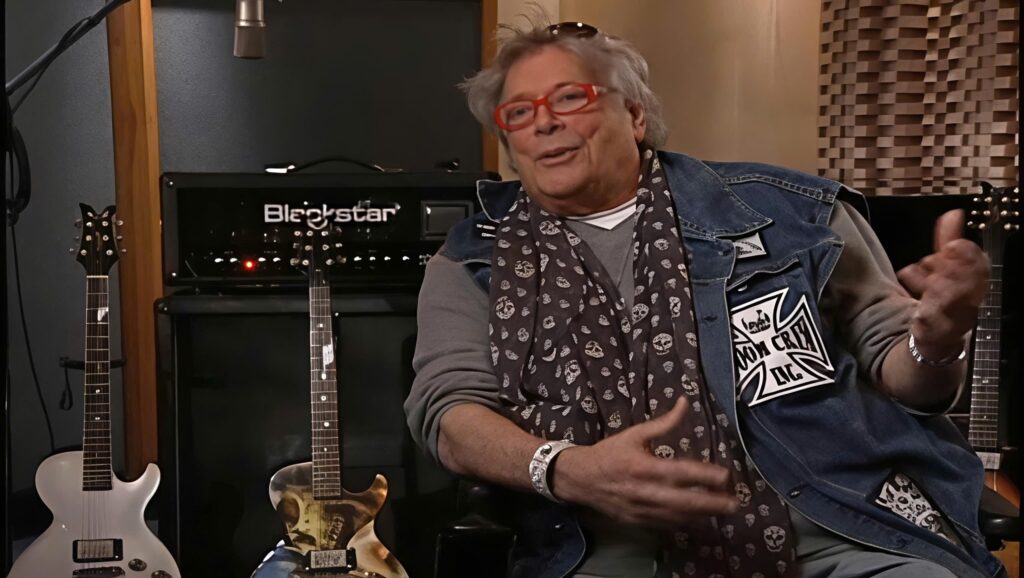
A rugged voice meets a timeless question, turning protest into something raw, wounded, and unmistakably human
When Leslie West released his 2005 interpretation of Blowin’ in the Wind, the moment carried a quietly powerful sense of lineage and reinvention. The song, originally immortalized by Bob Dylan in 1963, had already lived many lives by the time West approached it, from civil rights marches to smoky cafés to global stages. Yet when the guitarist known for his work with Mountain sat in a radio studio for The Howard Stern Show and performed it live, the result was not nostalgia and not imitation. Instead, it was a gritty, weathered reinterpretation that reflected not youth demanding answers, but a man who had lived long enough to feel the weight of the questions.
The core of West’s performance rests in his unmistakable voice. Where Dylan offered a thin poetic pleading, Leslie West delivered something heavier, blues-loaded, and scarred. His vocal phrasing brought out the ache between the words. You could hear gravel and mileage, but also tenderness. It sounded like someone who no longer asked the famous questions innocently, but because life had forced him to. His guitar work, rich and textured, created a slow-moving musical landscape where the lyrics had room to breathe. The spaces between his chords felt like pauses for memory, regret, or recognition.
The idea of covering a song as universally known as Blowin’ in the Wind poses a creative challenge. Most artists either treat it reverently or avoid it entirely. West approached it differently. Instead of wrapping it in folk purity, he infused it with blues soul and rock patience. The arrangement gave the song a new gravity, something close to confession rather than declaration. It is no longer a call to action. It becomes a mirror held against the years.
There is also something symbolic in the moment of performance. The setting was not a protest field or a record booth in Greenwich Village. It was a live broadcast in a modern media environment, one built more on shock, humor, and immediacy than historic folk tradition. And yet, the song transcended the room. It reminded listeners that even in altered times, even in formats dominated by personality and entertainment, certain songs remain larger than context.
In the hands of Leslie West, Blowin’ in the Wind becomes less a hymn of collective hope and more an intimate reckoning. Instead of a young man asking which way the answers drift, we hear an older voice accepting that many answers never arrived. The questions persist. The road stretches on.
That is why this version resonates. It does not try to compete with Dylan. It accepts the song as a living thing, one that changes shape depending on who holds it. And in 2005, when Leslie West played it, the song sounded like truth earned rather than truth imagined.