
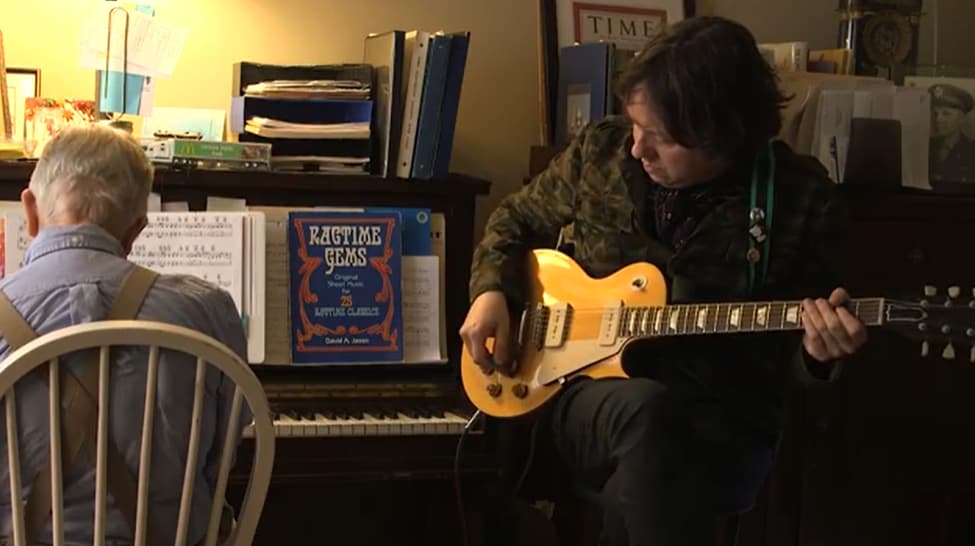
A quiet and tender reminder that music can outlive time and carry love across generations
When Bob Hill, at 83 years old, sat beside his son Dave Hill to perform their piano and guitar rendition of Stairway to Heaven, they created more than a cover of an iconic classic. They shaped a small but unforgettable moment where music became memory, connection and legacy. This recording never aimed for chart recognition or official release, yet it occupies a space charts cannot measure. It lives in the hearts of those who watch, listen, and immediately understand that they are witnessing something profoundly human.
In the hands of Led Zeppelin, Stairway to Heaven was an anthem of mysticism and ambition, a soaring epic of searching and transcendence. With Bob and Dave Hill, the same song becomes something quieter, more intimate and deeply reflective. There is no spectacle, no attempt to reproduce the grandeur of the original. Instead the arrangement is stripped to its essence, carried gently by piano, soft guitar and a voice seasoned by decades of life.
Bob’s playing reveals both delicacy and intention. Each note seems touched by experience, as if his hands remember every road, every loss, every joy. His voice is fragile yet full of warmth, shaped by time rather than worn by it. When he sings, there is no distance between words and meaning. His delivery feels lived in, personal, truthful. The lyrics that once spoke of youthful longing now feel like a letter written after the journey is nearly complete.
Dave’s guitar does not compete. It supports. His presence is patient and attentive, a musician and a son listening with his whole being. The two do not simply perform together. They breathe the music as one. And in that rare synchronicity lies the emotional center of the performance.
The transformation is subtle but powerful. The song shifts from a mythic quest into a meditation on love, memory and time. Youthful wonder becomes acceptance. Hope becomes gratitude. Longing becomes reflection. The stairway itself, once a symbol of escape or enlightenment, begins to resemble something simpler and more beautiful: the passage of a life well lived and a relationship cherished.
There is also something universal in the way this performance resonates. Anyone who has sat beside a parent, or watched them age, or wished for one more shared moment will recognize the invisible thread running through this version. It is not only a musical tribute. It is a conversation without words, a thank you, a gentle holding on.
By the final notes, the listener is left with stillness. Not sadness. Not nostalgia alone. Something deeper. A quiet recognition that music is one of the few things capable of carrying love across years, across memory and even across the silent spaces where language can no longer reach.
In a world full of noise, the Hills offered something rare: simplicity, sincerity and love set to a timeless melody.