
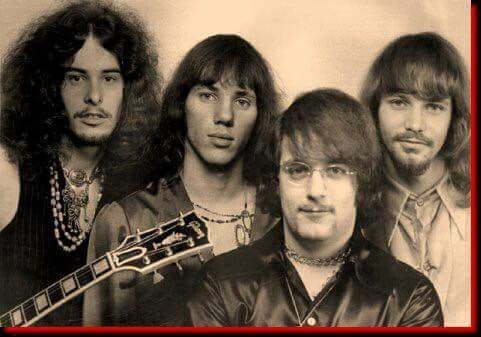
A Moment When Youthful Fearlessness and Musical Telepathy Collided in Pure Sonic Revelation
Captured in 1970 for WITF TV PBS, “Migration” by The Amboy Dukes, later circulated in remastered audio and video form, stands as one of the most electrifying documents of American hard rock and psychedelic fusion in its most exploratory phase. While the performance itself was never tied to a chart position, the Amboy Dukes were already a recognized force following their late 1960s success, and this broadcast preserved the band at a creative peak when ambition outweighed commercial calculation. Drawn from their evolving live repertoire rather than a single defining album moment, this version of “Migration” reveals a band stretching beyond song structure into something closer to a communal musical journey.
What makes this performance so arresting is not merely its power, but its sense of discovery. The Amboy Dukes approach “Migration” as an open landscape rather than a fixed composition. The song becomes a living organism, expanding and contracting with each player’s instinctive choices. At the center is Ted Nugent, still early in his career, wielding his Gibson Byrdland with startling control. His guitar tone is sharp, fluid, and expressive, blending jazz phrasing with raw rock aggression. Rather than dominating the performance, Nugent listens and responds, allowing the music to breathe and evolve organically.
Equally astonishing is the contribution of Andy Solomon on keyboards. His playing elevates the performance into another dimension entirely. Solomon does not simply color the sound, he shapes it, threading mystical textures and harmonic tension through the piece. His lines shimmer and surge, pushing the band into unexpected directions, lending the performance an almost spiritual intensity. This is keyboard work rooted in jazz sensibility and psychedelic exploration, executed with confidence far beyond his years.
The rhythm section provides the gravitational pull that keeps the journey grounded. Dave Palmer’s drumming is both muscular and precise, driving the music forward while remaining acutely responsive to every shift in dynamics. His sense of timing allows the band to stretch without losing cohesion. On bass, Greg Arama delivers a performance of remarkable authority. His lines are adventurous yet disciplined, locking in with Palmer while simultaneously engaging in dialogue with Solomon and Nugent. The bass does not merely support the harmony, it actively participates in the narrative, guiding transitions and intensifying climaxes.
What emerges from this performance is a rare example of four young musicians united by trust and curiosity. There is no sense of ego or restraint. Each member listens deeply, reacting in real time, creating a collective sound that feels spontaneous yet purposeful. The music carries a mystical quality, not because it relies on effects or theatrics, but because it reflects a genuine belief in exploration. This is rock music as a form of inquiry, a search for something just beyond reach.
Watching “Migration” today is a reminder of why moments like this endure. It captures the thrill of musicians discovering their limits by ignoring them entirely. The performance is fearless, dynamic, and profoundly alive. It invites repeated viewing not out of nostalgia alone, but because each pass reveals new details, subtle interactions, and flashes of brilliance. This is not simply a song or a broadcast. It is a document of youthful genius in motion, a testament to what happens when talent, trust, and imagination converge without compromise.