
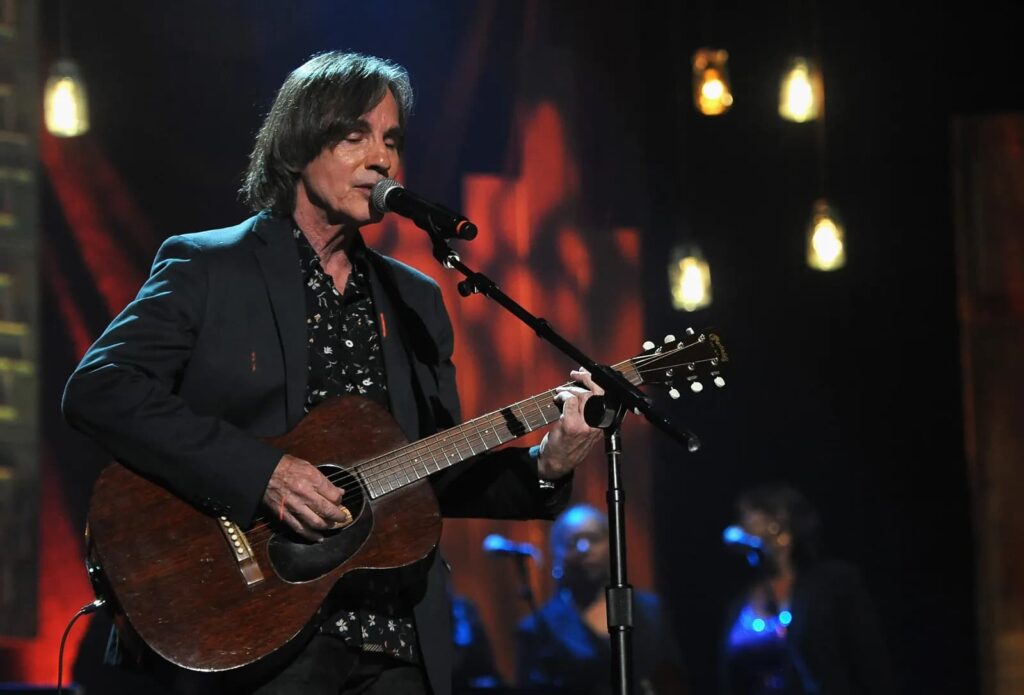
A Handshake Across Time: Jackson Browne and “Desperados Under the Eaves”
When Jackson Browne performed “Desperados Under the Eaves” at the Warren Zevon tribute concert, the song carried a gravity that extended far beyond its original 1976 studio recording. Though the song never charted as a single upon its release on Zevon’s seminal self-titled album (which Browne himself produced), it has long stood as one of the most revered compositions in the American songbook. In this tribute context, Browne’s interpretation transformed it into something even more profound. Sung in honor of Zevon—Browne’s longtime friend and a fellow chronicler of life’s battered souls—the performance felt less like a revival and more like a reckoning.
Originally written by Zevon during a period of turbulent living in Los Angeles, “Desperados Under the Eaves” is steeped in the quiet desperation of the transient. The song captures the psychic exhaustion of a city where ambition and isolation coexist in an uneasy balance. At the tribute concert, that exhaustion was no longer theoretical. Browne’s voice, seasoned by decades of living and loss, brought a lived-in authority to every line. The youthful, gin-soaked ache of Zevon’s original version matured through Browne into something heavier, slower, and infinitely more human.
Musically, the performance retained the song’s essential restraint. The melody moved with deliberate patience, allowing space for reflection rather than drama. Browne’s piano and phrasing emphasized the song’s emotional architecture, where each note felt as though it had earned its place. There was no attempt to embellish or modernize the arrangement; instead, Browne trusted the song’s quiet power, understanding that its strength has always come from honesty rather than spectacle.
Thematically, “Desperados Under the Eaves” has always been about survival in plain sight. Its narrator is not a rebel or a hero, but a man worn thin by routine, clinging to dignity while standing on the edge of emotional collapse. Performed as a tribute, that theme took on new resonance. Zevon spent his career writing about outsiders and drifters fighting private battles, and Browne’s performance felt like a final conversation between two artists who understood that vulnerability was not weakness, but truth.
What made this rendition especially affecting was its sense of communal memory. The audience was not simply listening to a song; they were witnessing a shared history of friendship, production, and mutual respect. Browne did not overstate the tribute. He allowed the lyrics to speak for themselves, trusting that those present understood the weight of Zevon’s absence. In doing so, he honored his friend not with grand gestures, but with pure empathy.
In this setting, the song became more than a reflection on Los Angeles or personal exhaustion; it emerged as a meditation on endurance—on continuing even when illusions fade and standing upright beneath the metaphorical eaves of life, battered but unbroken. For those familiar with the bond between the two men, the performance felt like a quiet handshake across time, a reminder that some songs do not age—they deepen.
This performance reaffirmed why Jackson Browne remains one of music’s most emotionally precise interpreters. He understands that the most lasting truths are often spoken softly, and that the greatest honor one artist can give another is to tell their story plainly, and without disguise.