
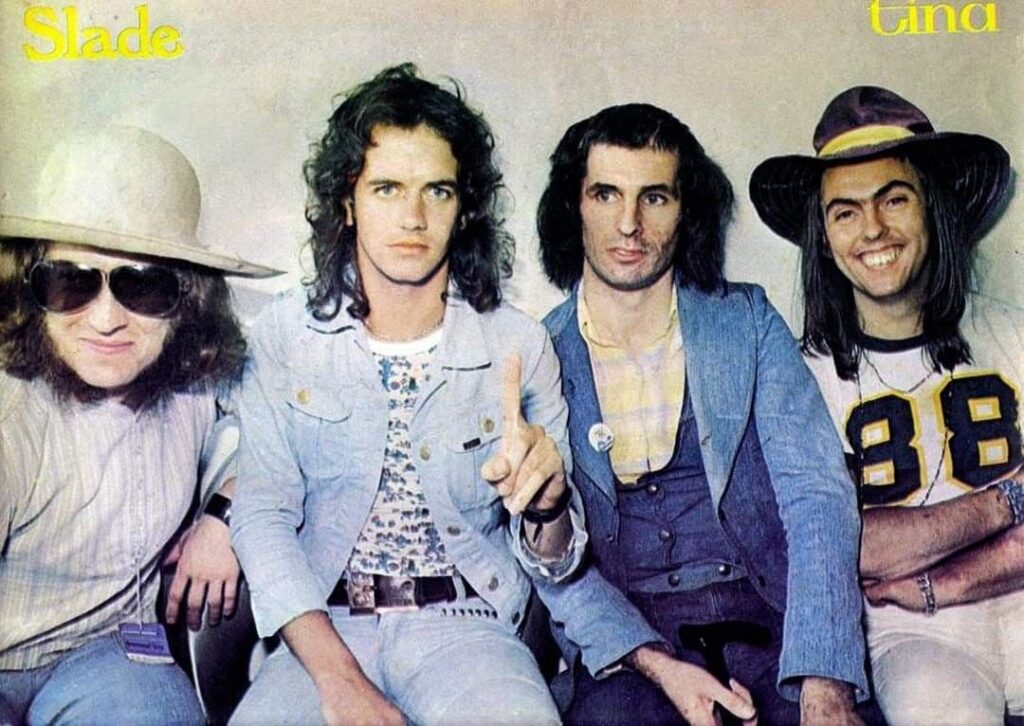
A thunderous declaration of devotion where raw emotion and sheer volume become one
When Slade roared through “Cuz I Love You” at De Vliegermolen in Voorburg in March 1973, the song was already etched into British rock history. Originally released in 1971, it had reached number one on the UK Singles Chart, announcing Slade as a dominant force at the dawn of the glam rock era. By the time of this Dutch performance, the song had evolved from a hit single into a live ritual, a cornerstone of Slade’s concerts and a defining statement of their emotional and musical identity.
On record, “Cuz I Love You” was revolutionary in its own right. Built around a slow, stomping groove and a dramatic dynamic shift, it rejected polish in favor of weight and intent. Noddy Holder’s vocal delivery was not smooth or romantic in a conventional sense. It was forceful, strained, almost desperate, as if love itself demanded to be shouted rather than whispered. That sense of urgency carried naturally into the live setting, and at De Vliegermolen, it intensified.
This performance captures Slade at a moment when their reputation as one of the most powerful live bands in Europe was fully earned. The venue becomes less a room and more a pressure chamber. Dave Hill’s guitar rings out with thick, metallic clarity, while Jim Lea’s bass locks into a relentless pulse that grounds the song in physical force. Don Powell’s drums do not merely keep time, they push and shove the song forward, amplifying its emotional stakes. Above it all, Holder commands the moment with a voice that feels scraped raw by feeling and volume alike.
Lyrically, “Cuz I Love You” is disarmingly simple, yet its simplicity is its strength. The words do not circle around love, they confront it directly. There is no irony, no detachment, no clever narrative disguise. Love here is absolute, overwhelming, and non negotiable. In the live context, especially in 1973 when Slade were speaking directly to a young, working class audience across Europe, that directness carried enormous power. It felt honest. It felt earned.
At De Vliegermolen, the audience response becomes part of the song’s structure. Cheers and shouts rise during the quiet passages, as if the crowd senses what is coming and braces for impact. When the song explodes back into full volume, it feels communal, almost cathartic. This was Slade’s great gift as a live band. They did not perform at their audience, they performed with them. Love, noise, sweat, and release were shared experiences.
Looking back, this 1973 performance stands as a document of Slade at their emotional and physical peak. Before stadiums and before nostalgia, they were still close enough to the floor that every shout mattered. “Cuz I Love You” in this setting is not just a song about devotion. It is proof that rock music can turn feeling into force, and that sometimes the truest expressions of love are the loudest ones, delivered without hesitation, straight from the gut to the room.
 Oldies Songs