
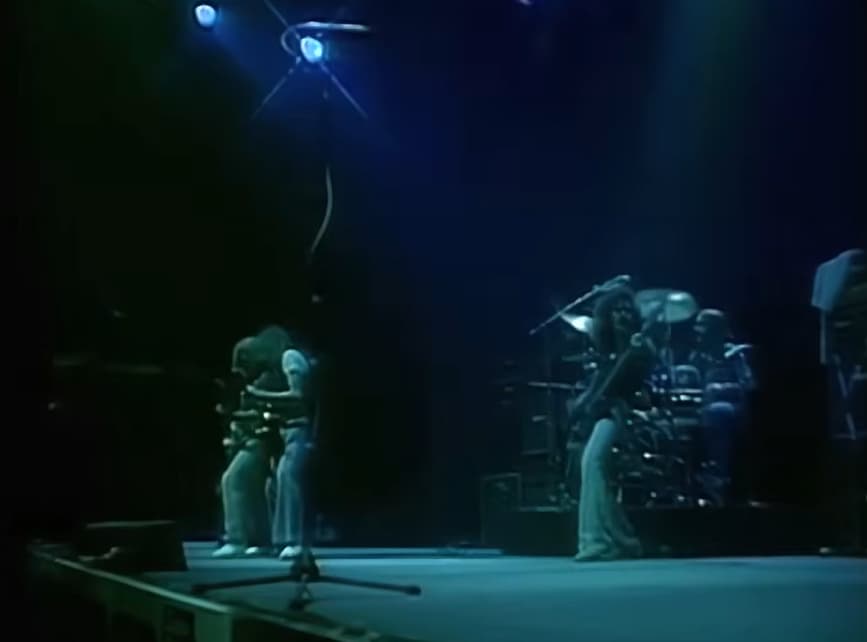
Status Quo at Stafford Bingley Hall 1977 A Broadcast Snapshot of a Band at Peak Momentum
The footage of Status Quo recorded at the New Stafford Bingley Hall on the ninth of January nineteen seventy seven offers a valuable televised document of the band during one of the most successful periods of their career. Captured as part of an ATV and ITC production titled The British Rock and Pop Awards 1976, the performance was later presented by Maurice Kinn for the Daily Mirror Pop Club, bringing Status Quo’s live power into homes across the United Kingdom.
By early nineteen seventy seven, Status Quo were firmly established as one of Britain’s leading live rock bands. Their run of hit albums and singles had been matched by a reputation for consistency on stage, built on relentless touring and a sound that audiences could trust. The Stafford Bingley Hall performance reflects this confidence clearly. Rather than presenting a staged studio appearance, the production chose to capture the band live in concert, preserving the atmosphere of a working show rather than a controlled television set.
Three tracks were selected from the concert and edited for broadcast. While the programme format required tightening the performance for television, the essential elements of Status Quo’s stage presence remained intact. The twin guitar approach of Francis Rossi and Rick Parfitt dominates the sound, supported by a solid and driving rhythm section. The emphasis is on momentum and groove rather than visual spectacle, staying true to the band’s identity.
The choice of venue is also significant. The New Stafford Bingley Hall was a large regional concert space that reflected the scale at which Status Quo were operating at the time. They were no longer a club band, yet they had not shifted toward theatrical production or elaborate staging. This balance between size and directness is evident in the footage, which shows a band focused entirely on delivery rather than presentation.
Maurice Kinn’s involvement as presenter added further credibility. As a respected music journalist closely associated with the Daily Mirror Pop Club, his presence framed the performance within a broader narrative of British popular music rather than youth television entertainment alone. The programme positioned Status Quo not as a passing trend, but as a central force in the rock landscape of the mid nineteen seventies.
From a historical perspective, the Stafford Bingley Hall footage is important because it captures Status Quo at full stride. There is no sense of reinvention or experimentation on display. Instead, the band performs with assurance, relying on material that audiences already knew and trusted. This televised appearance stands as a clear example of why Status Quo were regarded as one of the most dependable live acts of their era, capable of translating concert energy effectively to a national television audience.