
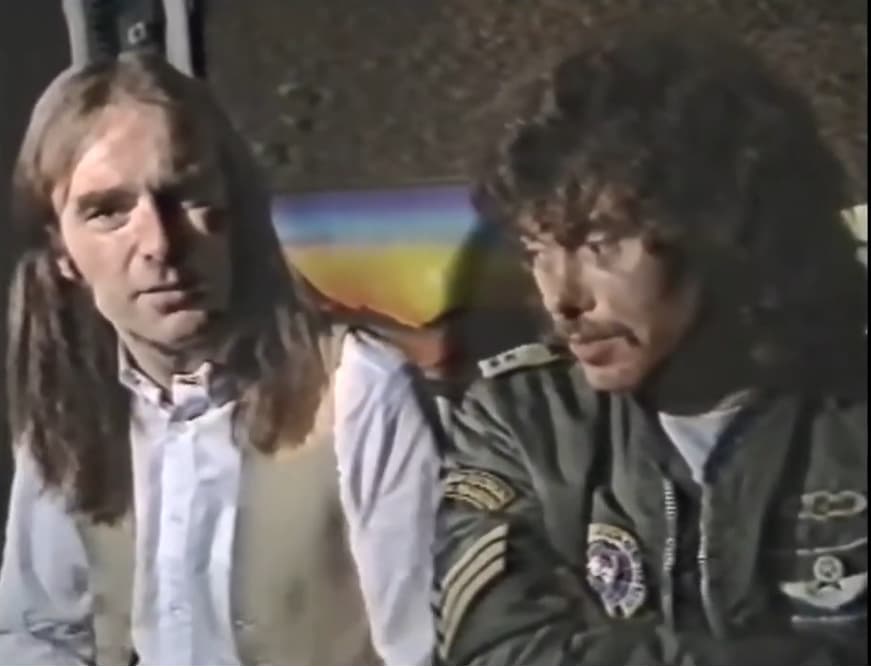
Status Quo Reflections on Success and Identity A 1982 BBC Interview with Francis Rossi and Alan Lancaster
In May of nineteen eighty two, two of Status Quo’s founding members, Francis Rossi and Alan Lancaster, sat down for an extended interview with the BBC that stands as one of the most candid and revealing moments in the band’s media history. Filmed at a time when Status Quo had already enjoyed more than a decade of sustained success, the conversation offers a detailed perspective on the group’s evolution, its relationship with the music industry, and the personal dynamics that shaped their journey.
By nineteen eighty two Status Quo had firmly established themselves as a mainstay of British rock. The band’s rise from mod inspired beginnings in the late nineteen sixties through to the hard boogie sound that defined their seventies catalog had been marked by consistent touring, prolific recording, and a series of charting singles and albums. The Rossi Lancaster interview arrived in the context of this legacy. Both musicians spoke with clarity about their influences, their working methods, and the challenges that come with longevity in a rapidly changing musical landscape.
Francis Rossi, the group’s lead guitarist and one of its principal songwriters, addressed how Status Quo developed their distinctive rhythmic approach. Rossi explained that the band’s signature sound was never the result of a conscious attempt to create a trademark style. Instead, he described it as an organic outcome of how the members played together in rehearsal and on stage. This emphasis on live performance and group interplay emerged as a central theme in the interview. Rossi talked about the importance of the road in shaping their music, noting that constant live engagement with audiences sharpened the band’s focus and honed their dynamics.
Alan Lancaster, the band’s original bassist and a key contributor to their early sound, offered his own reflections on the evolution of band roles and expectations. Lancaster spoke at length about the balance between personal expression and collective identity. He acknowledged that over time the group had to reconcile individual musical preferences with a coherent band direction. His remarks illustrated both the creative tension and mutual respect that underpinned Status Quo’s ability to function as a unit after years of close collaboration.
The BBC interview also touched on the broader music industry context of the early nineteen eighties. Rossi and Lancaster discussed how trends such as punk and new wave had shifted public attention, yet they also emphasized their commitment to remaining true to their own musical instincts. Neither showed evidence of chasing trends for the sake of commercial survival. Instead, both conveyed a steady confidence in the band’s established style and audience connection.
One can watch this interview today and appreciate it as a moment of self reflection from two musicians at the heart of a successful and enduring career. Their answers are thoughtful and grounded rather than promotional or scripted. It provides insight not only into Status Quo’s past achievements but also into how they viewed themselves at a pivotal moment, with decades of experience behind them and continued work ahead.
The Rossi Lancaster BBC interview remains a valuable document for fans and historians alike. It captures the voice of a band whose consistency, work ethic, and focus on performance made them one of Britain’s most resilient rock acts. It is a reminder that success in music is as much about sustained commitment as it is about individual hits.