
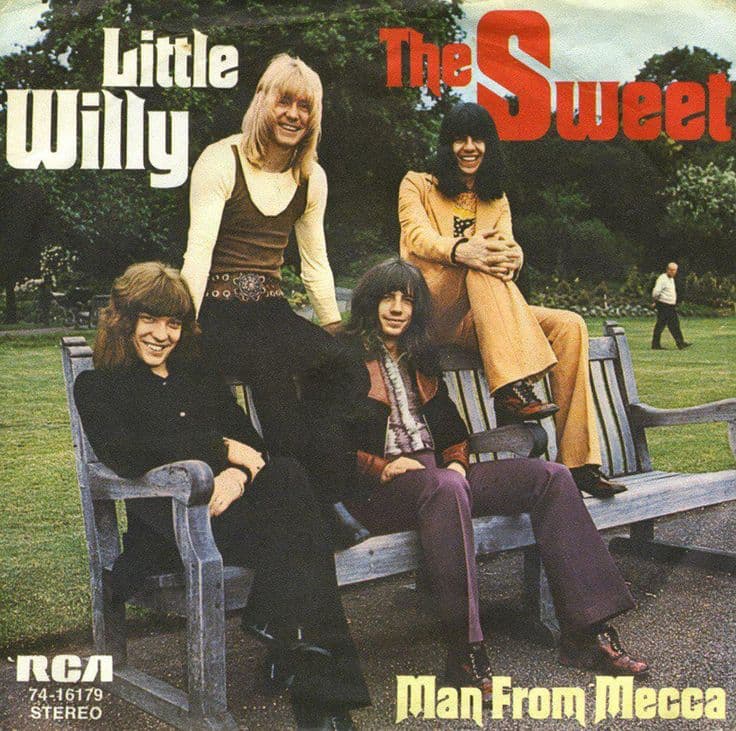
A Deceptively Innocent Anthem That Captured the World, a Heartbreaking Chronicle of a Band Trapped by Its Own Success.
In the chaotic, glittering world of 1970s glam rock, one band embodied the genre’s duality more than any other. On one hand, Sweet was a theatrical force, a group of powerful musicians who loved to rock with a hard, heavy edge. On the other, they were a pop-music machine, churning out bubblegum anthems meticulously crafted by a Svengali-like songwriting team. It was this intense, internal conflict that became the central drama of their career. And no song represents this tug-of-war more perfectly than “Little Willy.” Released as a standalone single in 1972, this song was a global sensation, but its success came at a painful price. While it only reached a respectable number 4 on the UK Singles Chart, it was an absolute monster in the United States, soaring to a peak of number 3 on the Billboard Hot 100, becoming their biggest hit in America. This success cemented the band’s pop identity in the eyes of the public, even as they longed to break free.
The story behind “Little Willy” is a classic music industry tragedy. The song was written by the legendary team of Nicky Chinn and Mike Chapman, who had penned a series of sweet, catchy hits for the band. The lyrics are a simple, lighthearted tale of a boy who’s too shy to come out and play, but with a subtle, winking quality that made it feel just a little bit naughty. It was an instant earworm, a song designed for pure, unadulterated fun. But for the band, particularly bassist Steve Priest and drummer Mick Tucker, the song was a symbol of everything they resented. They were serious musicians who wanted to write their own material, to be known for their heavier, more complex sound. Instead, they were being forced to perform songs they didn’t write, dressed in outlandish costumes and reduced to a pop commodity. The more successful “Little Willy” became, the more they felt trapped, their artistic ambitions stifled by the very hits that were making them famous.
The emotional core of “Little Willy” lies in this profound dramatic irony. On the surface, it’s a song about playful innocence. But beneath that simple facade is a painful story of creative confinement. The joyous, hand-clapping chorus, the bright, sing-along melody—all of it felt like a gilded cage. It was a perfect storm of success and resentment, a moment when the public fell in love with a song that was, for the artists, a source of constant frustration. The song was later placed on a US compilation album titled The Sweet, reinforcing its status as a commercial powerhouse in America.
For those of us who remember the era, “Little Willy” is a time capsule, a powerful reminder of a time when glam rock was just as much about pop as it was about rebellion. It’s a song that evokes a deep sense of nostalgia for a simpler time, when an infectious melody and a clever hook were all it took to conquer the world. It stands as a testament to the complex, often contradictory, nature of fame and art. While the song itself was a source of internal conflict for the band, it became an enduring anthem of pure, unpretentious fun for millions. It is a timeless piece of music, a quiet masterpiece that continues to resonate with its raw, emotional power and its beautifully tragic backstory.