
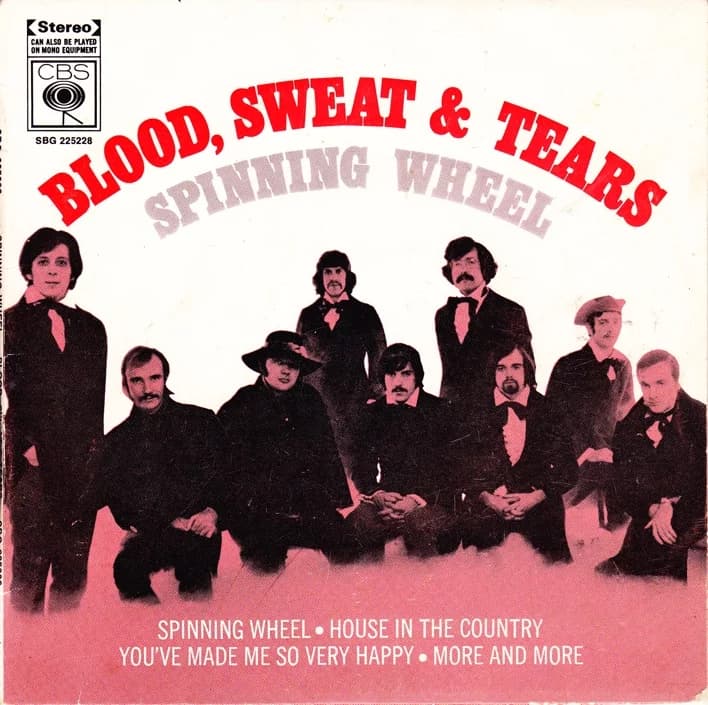
A Profound Musical Meditation on Fate, a Timeless Reflection on the Unpredictable, Cyclical Nature of Life.
In the late 1960s, a seismic shift was happening in the world of music. As psychedelic rock and folk protests dominated the airwaves, a new and sophisticated sound began to emerge, a powerful fusion of rock’s raw energy with jazz’s intricate complexity. This movement was epitomized by a band with a name as dramatic as their sound: Blood, Sweat & Tears. At a critical juncture in their career—after the departure of their founding leader—they released their self-titled second album in late 1968, a record that would become a landmark in American music. At its very heart was a song that wasn’t just a hit; it was a philosophical statement set to a symphony of horns. That song was “Spinning Wheel.” Released as a single in 1969, it was an undeniable phenomenon, spinning its way to a peak of number two on the Billboard Hot 100 and earning a Grammy Award for its brilliance.
The story behind “Spinning Wheel” is a powerful testament to the triumph of art over adversity. The band’s debut album had been a critical success, but internal strife led to a major lineup change, including the high-profile departure of founder Al Kooper. The remaining members, now with the soulful and commanding voice of new lead singer David Clayton-Thomas, had everything to prove. They were under immense pressure to show that they could not only survive but thrive. It was during this period of high-stakes uncertainty that Clayton-Thomas penned the song. The drama of its creation unfolded in a moment of quiet, personal reflection. The songwriter, grappling with the relentless ups and downs of his own life, from penniless struggle to the dizzying heights of fame, found a simple, powerful metaphor for the unpredictable nature of fate: a spinning wheel.
The song’s theatrical power lies in its structure, a perfect musical representation of its lyrical journey. It begins with a hushed, contemplative acoustic guitar and a gentle vocal, a quiet moment of introspection before the storm. Clayton-Thomas’s voice, rich with a lived-in melancholy, delivers the song’s core thesis with a profound simplicity: “What goes up must come down / Spinnin’ wheel, got to go ’round.” This lyrical drama is a universal lament, a reflection on the fleeting nature of success and the inevitability of change. Then, as if an inner voice of triumph takes over, the song explodes. The mighty brass section—a character in its own right—rushes in with a joyous, soaring exclamation, turning the song from a quiet reflection into a powerful, defiant anthem. It’s a moment of cathartic release, a musical declaration that while life’s wheel may keep spinning, you can choose to embrace the ride.
For those of us who remember this era, “Spinning Wheel” is more than a song; it’s a touchstone. It takes us back to a time when musicians were unafraid to blend genres and tackle big ideas. It’s a nostalgic reminder of a moment when pop music could be both smart and universally appealing. The song’s enduring power lies in its timeless message. It speaks to the universal experience of navigating the unpredictable journey of life, reminding us that every low is temporary and every high is a gift. It is a cinematic, deeply emotional piece of music that continues to resonate with its raw honesty and its triumphant, beautiful sound.