
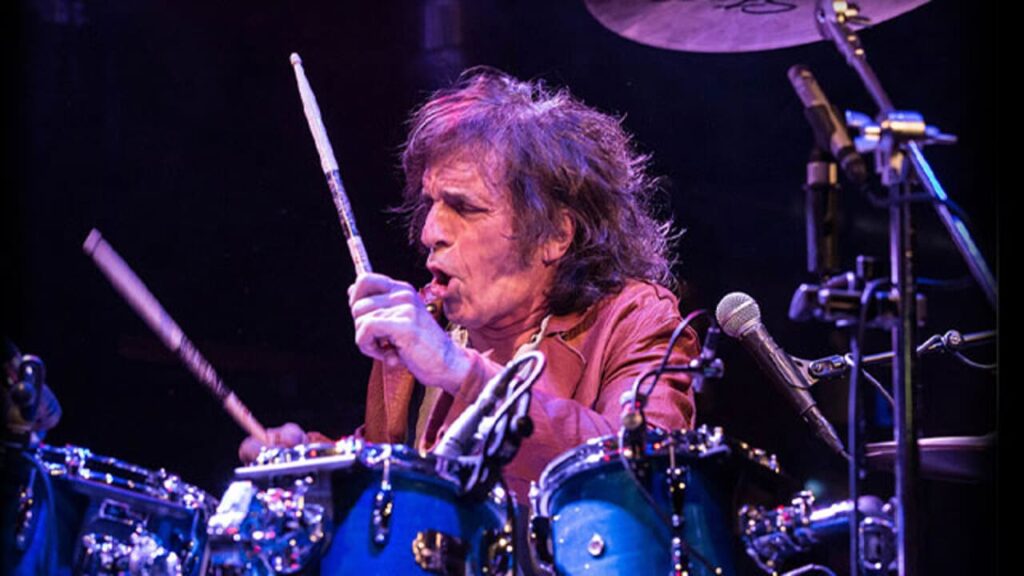
A Lone Drummer Reimagines a Mythic Farewell to Friendship, Freedom, and the Wide Open West
When Corky Laing, the rhythmic heart of Mountain, released his 2017 interpretation of “Theme For An Imaginary Western”, it arrived not as a chart-bound single but as a deeply personal artistic statement. The song, immortalized by Mountain on their 1970 album Climbing!, had long stood as one of the band’s most poetic and emotionally expansive works. Laing’s later rendition, issued decades after the original and framed by time, loss, and reflection, transformed the piece into something quieter and more introspective, a veteran musician revisiting a shared memory and allowing it to speak with new gravity.
Originally written by Jack Bruce and lyricist Pete Brown, “Theme For An Imaginary Western” became a cornerstone of Mountain’s identity, largely through the emotional weight brought by Leslie West’s guitar and Laing’s thunderous yet sensitive drumming. In the 2017 version, however, the emphasis shifts. Laing steps forward not as the driving force behind a power trio, but as a storyteller looking back across a long horizon. The western imagery that once felt romantic and expansive now carries the resonance of farewell, as if the frontier itself has aged alongside its narrator.
Musically, Laing’s approach reflects restraint and reverence. Where the original version balanced grandeur with muscular rock dynamics, the later interpretation leans into atmosphere and reflection. The rhythm no longer charges ahead like a galloping horse, but moves with a measured pace, echoing the steady footsteps of someone revisiting familiar ground. The arrangement allows space for emotion to breathe, and that space becomes the song’s most powerful instrument. Silence, phrasing, and texture replace force, revealing Laing’s deep understanding of when not to play.
Lyrically, the song has always been about departure, identity, and the quiet dignity of moving on. In 2017, those themes feel magnified. Lines that once suggested youthful restlessness now resonate as meditations on legacy and brotherhood. The imaginary western becomes a symbolic landscape where past and present coexist, a place where musicians, friendships, and dreams ride together one last time. Laing’s interpretation does not attempt to surpass the original, nor does it rewrite its meaning. Instead, it reframes it, allowing age and experience to deepen its emotional truth.
Culturally, this version stands as a testament to endurance. Few artists are willing to return to their defining material after decades, especially when the collaborators who shaped it are no longer present. Laing’s performance feels like a conversation with memory itself, honoring the spirit of Mountain while acknowledging the passage of time. It reminds listeners that classic songs are not static monuments but living entities, capable of evolving as their creators do.
In revisiting “Theme For An Imaginary Western”, Corky Laing offers more than a reinterpretation. He offers a reflection on brotherhood, mortality, and the enduring pull of the road. It is the sound of a man standing at the edge of a vast musical landscape, tipping his hat to the past, and letting the echo carry forward into the open air.