
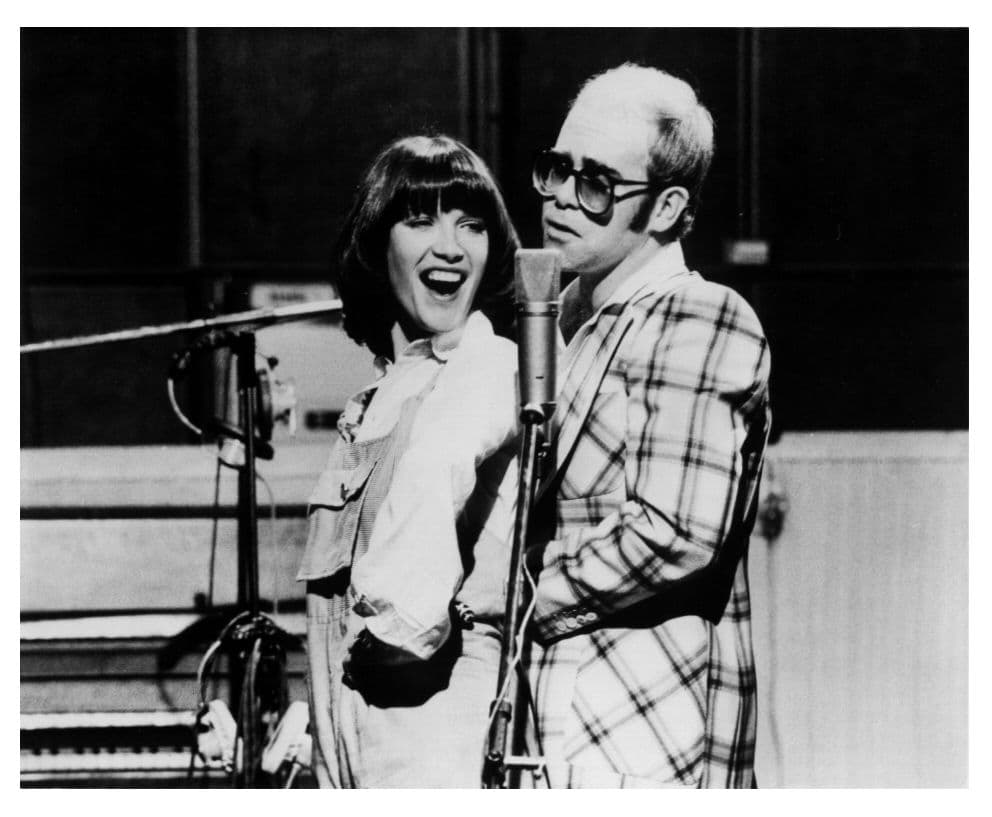
A Joyful, Theatrical Plea for Mutual Commitment, Forged in a Moment of High-Stakes Pop Perfection.
By the summer of 1976, Elton John was less an artist and more a global institution, a flamboyant monarch reigning over the kingdom of rock and roll. His output was prodigious, his fame immense, yet the landscape of his career was in a state of flux. He had momentarily stepped away from his foundational partnership with lyricist Bernie Taupin, seeking new collaborators and new sounds. It was in this moment of experimentation and creative restlessness that he paired with Kiki Dee, a immensely talented singer signed to his own label, Rocket Records, who was on the precipice of international stardom. The result of this high-stakes collaboration was a monumental piece of pop drama: the single “Don’t Go Breaking My Heart.” This joyous, infectious duet was an immediate phenomenon, rocketing to Number 1 on the UK Singles Chart and, crucially, becoming Elton John’s first Number 1 hit on the US Billboard Hot 100. Released as a standalone single, its spectacular, dual-nation success instantly enshrined it as a historic landmark in 1970s pop.
The story behind the song is a tale of deliberate, affectionate pastiche. Elton John, who penned the music, conceived of the track as a conscious homage to the great, theatrical Motown duets of the 1960s, particularly the dynamic, flirtatious exchanges between Marvin Gaye and Tammi Terrell. The lyrics, full of playful dialogue and romantic tension, were crafted by Elton John (credited on some early releases under the whimsical pseudonym Carte Blanche) with Gary Osborne. The core drama lies not in the song’s depth, but in its perfectly choreographed surface—a brilliant, breezy performance that contrasts sharply with the often-chaotic personal lives of the rock stars involved. For Kiki Dee, the impact was transformative. This single was her spectacular leap from dedicated, talented artist to a household name and a global chart-topper, orchestrated by her famous mentor in a high-stakes gamble that paid off spectacularly.
The meaning of “Don’t Go Breaking My Heart” is simple, universal, and profoundly relatable, told through the medium of a theatrical call-and-response. It is the dialogue of two people who are terrified of getting hurt but cannot resist the intoxicating pull of a new love. The music’s buoyant, piano-driven groove and the warm orchestral arrangements provide the perfect setting for this emotional tug-of-war. The power of the track is the undeniable, magnetic chemistry between Elton and Kiki. They don’t just sing the lyrics; they act out the nervous excitement of a budding romance. Their voices—one pleading, the other reassuring, both brimming with hopeful anxiety—create a delicious tension that resonates with older listeners, stirring deep nostalgia for the innocence and high stakes of young love.
Ultimately, “Don’t Go Breaking My Heart” was much more than a chart record; it was a cultural moment, a defining flash of pop brilliance that cemented the summer of 1976. It stands as a testament to Elton John’s enduring pop genius and his generous, game-changing support of a gifted protégé. For those who lived through the era, the song remains a potent, joyous memory—a piece of perfectly constructed musical drama whose enduring power lies in its ability to make us believe, for four blissful minutes, in the absolute, hopeful security of mutual commitment.