
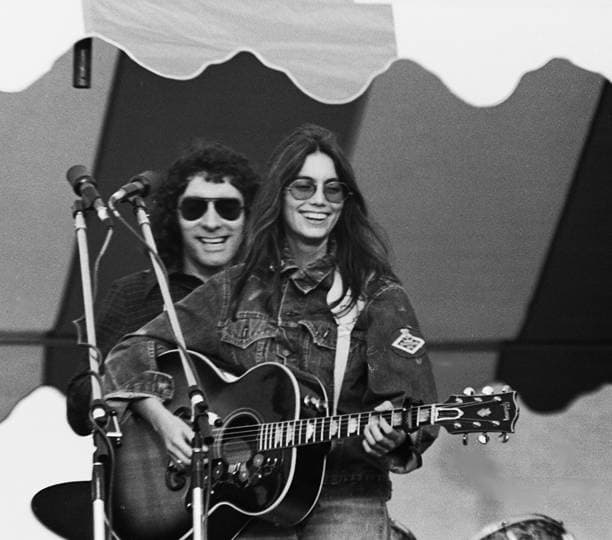
A Gentle Reimagining of a Timeless Classic, a Masterful Transformation of a Pop Ballad into a Country-Folk Hymn of Love.
There are certain songs so fundamentally perfect that to cover them seems an act of hubris. Paul McCartney’s “Here, There and Everywhere,” from the Beatles’ 1966 masterpiece Revolver, is one such song, a crystalline piece of melodic genius that many consider to be one of the greatest love songs ever written. So, when a young Emmylou Harris chose to reinterpret this untouchable classic in the mid-1970s, it was a bold, even audacious move. Her version, released in late 1975 on her seminal album Elite Hotel, became a minor but significant hit, proving not only her impeccable taste but also her unique ability to breathe new life into a well-known tune. The song’s success was a quiet testament to her growing star power, reaching number 65 on the Billboard Hot 100 and a more impressive number 13 on the Adult Contemporary chart in the United States. In the UK, it found a wider audience, climbing to number 30 on the Official UK Singles Chart.
The story behind Emmylou Harris’s choice to record “Here, There and Everywhere” is one of artistic vision and a deep appreciation for the craft of songwriting. By 1975, Harris was on the cusp of becoming a major force in country and folk music. Her collaboration with the late Gram Parsons had cemented her reputation as an artist with a rich, authentic voice, but it was on her own, with her band the Hot Band, that she truly began to flourish. For Elite Hotel, she curated a collection of songs that spanned from her own compositions to traditional country fare and, most surprisingly, a Beatles classic. Producer Brian Ahern, a key figure in her early career, helped shape the delicate, acoustic-driven sound that made her version so distinctive. The song’s meaning, a simple yet profound ode to being in love, transcended its pop origins and found a new home in the earnest, heartfelt delivery of Harris. She stripped away the lush harmonies of the Beatles’ version, replacing them with her own pure, unadorned vocal and a sparse, melancholic arrangement, which highlighted the song’s timeless melody and poignant lyrics.
For those of us who recall the 1970s music scene, Emmylou Harris’s rendition of “Here, There and Everywhere” was a gentle but firm statement. In an era when pop and rock were becoming increasingly slick and bombastic, she offered a moment of quiet reflection, a return to the essentials of a good song: a beautiful melody, a compelling lyric, and a voice that feels like a warm embrace. Her version feels less like a performance and more like a private, intimate conversation with the listener. The song’s meaning, about the joy of a lover’s presence in every corner of one’s life, takes on a new shade of wistful, knowing maturity in Harris’s hands. It is the sound of a woman who understands the delicate, fragile nature of love and the enduring comfort of a shared connection. This isn’t the fleeting infatuation of youth; it’s a deep, abiding devotion, sung with the kind of grace that only comes from a life fully lived.
Decades later, the song’s legacy continues to grow. Its enduring power was recently re-highlighted when artist Frank Ocean famously interpolated its lyrics on his 2016 song “White Ferrari,” giving a Lennon-McCartney writing credit and introducing the melody to a new generation of listeners. For those of us who grew up with Emmylou Harris and remember hearing her sweet, haunting voice on the radio, her version remains a powerful and cherished memory, a reminder that the purest expressions of love can be found not just here or there, but truly, everywhere.