
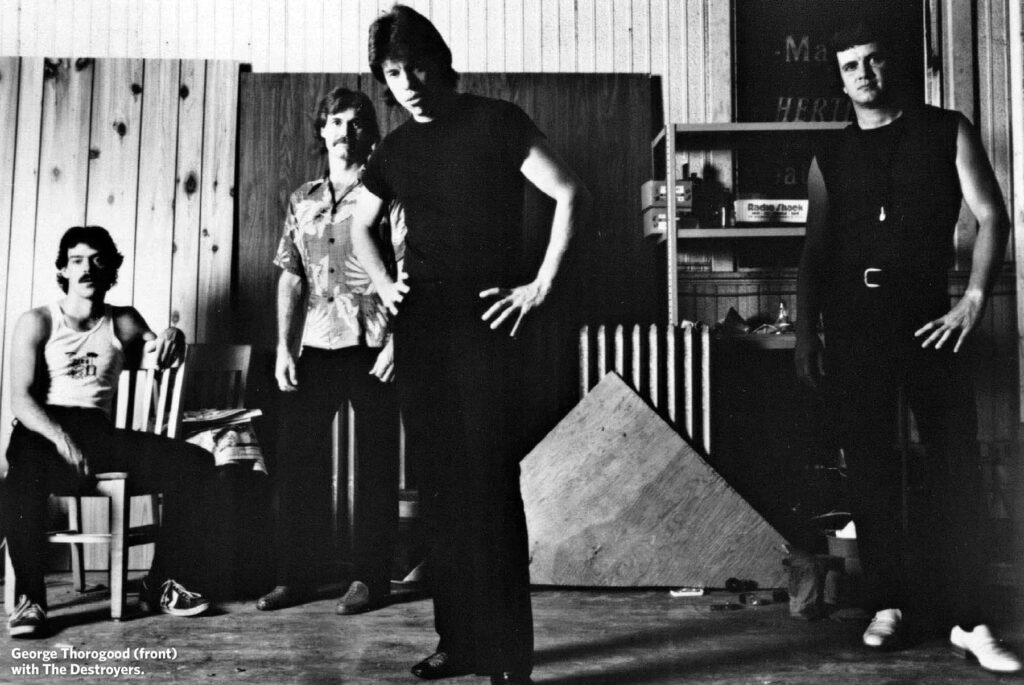
“One Bourbon, One Scotch, One Beer”: A Blues-Rock Chronicle of Desperation, Defiance, and Down-and-Out Living.
There are songs that capture a mood so perfectly, so viscerally, that they become a cultural touchstone for a particular kind of raw, down-on-your-luck sentiment. For those of us who appreciate the gritty heart of blues and rock and roll, George Thorogood And The Destroyers’ iconic performance of “One Bourbon, One Scotch, One Beer” stands as a monumental masterpiece of storytelling and swagger. Released in 1977 on their self-titled debut album, George Thorogood And The Destroyers, this track is not merely a song; it’s a theatrical monologue, a cinematic journey into the soul of a desperate man seeking oblivion and temporary solace at the bottom of a glass. For older readers, it conjures a potent memory of a time when blues and hard rock intertwined, and a well-told story could hold you captive from the first note to the very last.
While it was not released as a single at the time and therefore did not appear on any major commercial singles charts, the impact of “One Bourbon, One Scotch, One Beer” was immediate and enduring, cementing its place as George Thorogood And The Destroyers’ signature song and a staple of album-oriented rock (AOR) radio. The album, George Thorogood And The Destroyers, itself was a slow-burn success, peaking at number 92 on the Billboard 200 album chart. Its true legacy, however, was forged on the road and in the hearts of rock fans who embraced its raw, unpolished authenticity. The song’s notoriety grew exponentially through the band’s relentless touring schedule and its consistent airplay on rock radio stations, becoming a certified live classic long before it was widely known as a studio track. For those who were there, hearing Thorogood’s distinct, slinky guitar riff and his growling, conversational vocal delivery was an instant signal that the party, and the story, was just beginning.
The story behind “One Bourbon, One Scotch, One Beer” is a fascinating journey through the history of blues music. The song itself is a medley of two separate blues tunes. The first part, “One Scotch, One Bourbon, One Beer,” was written by Rudy Toombs and first recorded by Amos Milburn in 1953. It tells the story of a man who has been kicked out of his house by his lover and pleads with a bartender to keep the drinks coming as he awaits his next round. The second part, which tells the story of the man’s predicament, was originally part of a song called “House Rent Blues” by John Lee Hooker, who recorded his own version of a combined medley in 1966.
George Thorogood and his band, The Destroyers, masterfully fused these two narratives into a single, cohesive, and utterly compelling performance. Thorogood’s genius lay not just in his muscular, slide-guitar-driven arrangement, but in his theatrical, almost conversational vocal delivery. He didn’t just sing the story; he acted it out, giving life to the desperate protagonist who has been thrown out of his apartment and pleads for just one more drink. He brought a sense of gritty, lived-in realism to the lyrics that previous versions, while classic in their own right, never quite captured.
The meaning of “One Bourbon, One Scotch, One Beer” is a raw and timeless exploration of desperation and the human need for escape. The protagonist is not just asking for a drink; he is bargaining for time, for a temporary reprieve from his problems, and for the courage to face his imminent homelessness. The bartender’s refusal to serve him until he pays for the last round creates a tense, dramatic conflict that is both humorous and heartbreaking. It’s a powerful narrative about hitting rock bottom, of a man whose only remaining currency is a promise and a prayer. For older readers, this song isn’t just about drinking; it’s about the universal experience of hardship, of being down on one’s luck, and the bittersweet solace found in a moment of escape. It’s a testament to the enduring power of the blues to tell a story that is profoundly human, and George Thorogood And The Destroyers’ version stands as the ultimate chapter in that story.