
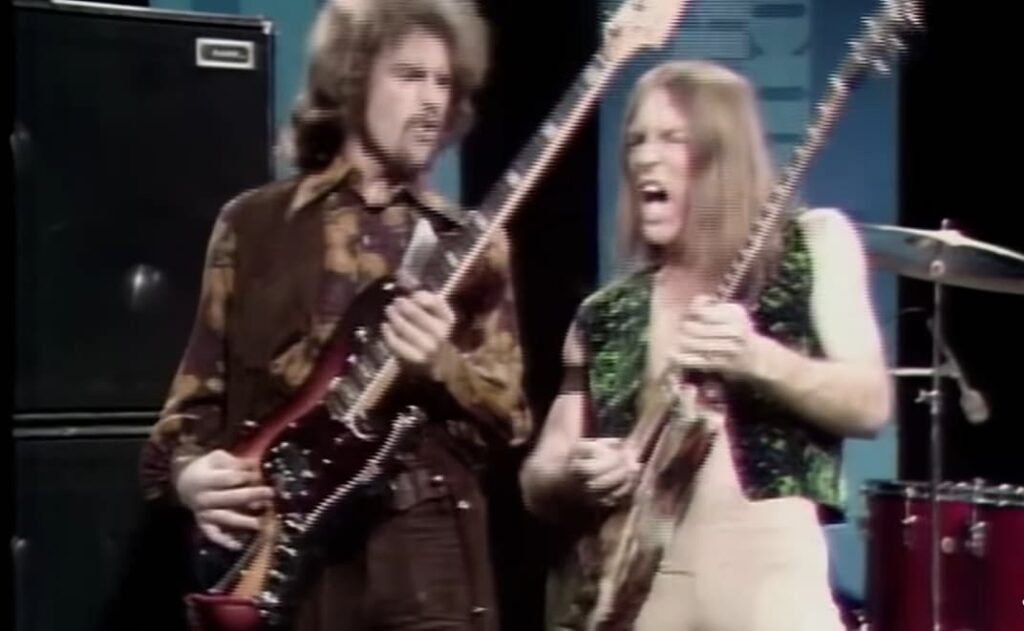
Breaking the Walls from the Inside: Grand Funk Railroad and the Raw Power of “Inside Looking Out”
When Grand Funk Railroad recorded “Inside Looking Out” in 1969, they were not simply covering a song. They were reshaping it into a declaration of identity. Built on grit, repetition, and relentless momentum, their version transformed an already heavy piece of music into something darker, louder, and more confrontational. It became one of the defining moments of the band’s early years and a clear signal of how far they were willing to push raw rock energy.
The song’s roots run deep. Originally released in 1966 by The Animals, “Inside Looking Out” was loosely based on a traditional work chant called “Rosie,” collected by musicologist Alan Lomax and preserved in his Popular Songbook. The Animals’ version carried a sense of confinement and frustration, shaped by blues tradition and social tension. It performed strongly in the UK, reaching number 12 on the Singles Chart, and found moderate success in Canada and the United States. But it was Grand Funk Railroad who stripped the song down to its most primal elements.
On their 1969 album Grand Funk, the Michigan power trio reimagined the track with a heavier frame and a more aggressive attitude. Mark Farner, handling guitar, harmonica, and vocals, approached the song as a slow burn rather than a conventional single. His guitar work was raw and repetitive, digging into a single idea and refusing to let go. The harmonica added a desperate edge, while his vocal delivery felt more like a demand than a performance.
The rhythm section gave the song its unstoppable force. Don Brewer’s drumming was direct and unpolished, locking the groove in place with almost hypnotic persistence. Mel Schacher’s bass rumbled underneath everything, thick and dominant, turning the track into a physical experience rather than a melodic one. Together, the three musicians created a sound that felt claustrophobic in the best possible way, mirroring the song’s themes of confinement and resistance.
Grand Funk also made subtle but telling lyrical changes, including references to marijuana culture, such as altering “rebirth” to “reefer.” These adjustments were not made for shock value alone. They reflected the countercultural reality of the late nineteen sixties, grounding the song firmly in its new era. The result was not a cover that honored the original politely, but one that claimed it entirely.
What sets Grand Funk Railroad’s “Inside Looking Out” apart is its refusal to resolve neatly. The song stretches, circles, and repeats, emphasizing tension rather than release. This approach divided critics at the time but resonated deeply with audiences. It captured the band’s core appeal: music that felt unfiltered, loud, and unapologetically physical.
Over the years, the song’s influence continued to ripple outward. It was reworked by Novak’s Kapelle in 1969 as “Hypodermic Needle,” later interpreted by doom metal band The Obsessed, revived by The Greenhornes, and even revisited live by Eric Burdon himself in 2001. Yet Grand Funk Railroad’s version remains the most imposing.
“Inside Looking Out” stands today as a cornerstone of Grand Funk’s legacy. It reflects a moment when rock music leaned fully into volume, repetition, and attitude, trusting feel over refinement. More than fifty years later, it still sounds like a band pushing against the walls, determined to be heard on its own terms.