
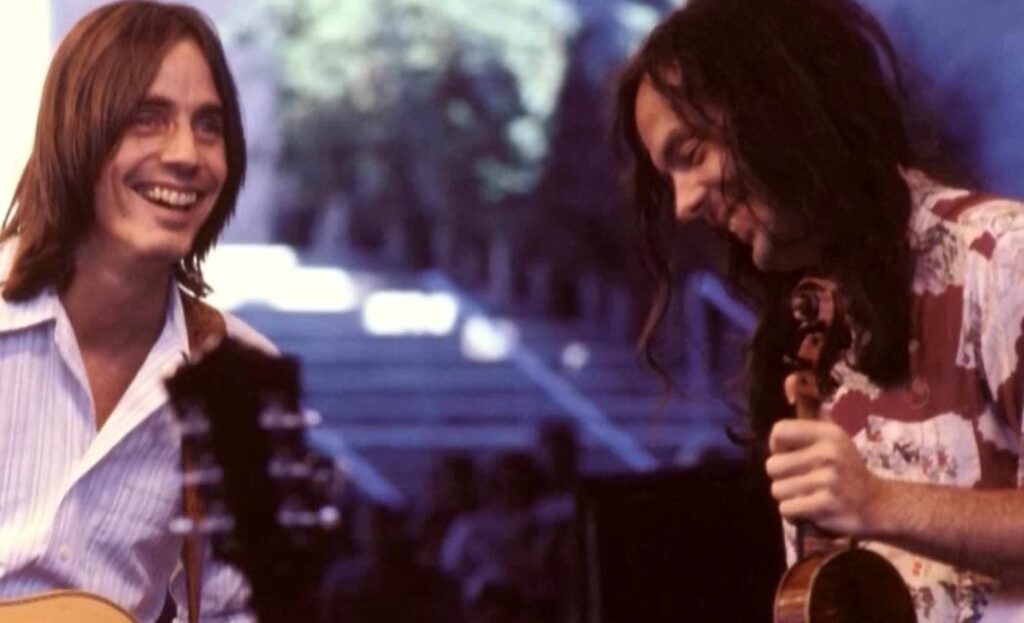
A Joyful and Poignant Live Reunion, a Medley of Enduring Love’s Complexity and its Simple, Desperate Plea.
The year 2010 brought with it a profound wave of nostalgia for fans of the Southern California sound, marking the release of Love Is Strange: En Vivo Con Tino. This live album, recorded during a 2006 tour, was not merely a collection of songs; it was a deeply emotional reunion between two towering figures of their era: the confessional poet Jackson Browne and the eccentric, virtuoso multi-instrumentalist David Lindley. Their shared history, a volatile but brilliant tapestry woven over decades, gave this late-career collaboration an immense dramatic weight. While the album itself was a commercial success, reaching number 50 on the Billboard 200, the song at its heart—the spontaneous, effervescent medley “Love Is Strange / Stay”—was never a single and never charted. Its value is purely artistic, a perfect, fleeting moment of on-stage chemistry captured for eternity.
The story of this medley is the drama of enduring musical friendship. Jackson Browne and David Lindley had been creative partners whose paths, while often diverging, were always intrinsically linked. For their audience, seeing them back on stage together, particularly with the added cultural tapestry of the live Spanish recording, was a powerful emotional event, a bridge back to the golden era of folk-rock. The medley, in this context, becomes a theatrical representation of their relationship and their musical past. The contrast between Browne, the earnest balladeer, and Lindley, the unpredictable genius whose slide guitar weeps and wails with unmatched feeling, creates a visual and aural tension that is pure, high-stakes rock and roll. The performance is a joyful, spontaneous outpouring of shared history.
The structural drama of the medley is breathtakingly effective. It begins with the relaxed, conversational groove of “Love Is Strange” (originally by Mickey & Sylvia). This opening piece establishes a scene of adult complexity, acknowledging the messiness and inherent confusion of relationships. It sets a stage where love is fickle, unpredictable, and sometimes downright hard. This nuanced contemplation then melts, with seamless, magical transition, into the childlike simplicity of “Stay” (originally by Maurice Williams and the Zodiacs, but famously covered by Browne on Running on Empty). That three-minute explosion of pure, raw desire—the desperate plea of “Oh, won’t you stay / Just a little bit longer”—strips away all the ambiguity of the first song, revealing the fundamental, human fear of abandonment. The medley, therefore, becomes a complete emotional arc: love is strange, complicated, and often bewildering, but the bottom line is always the same: we simply want it to last.
For older listeners, “Love Is Strange / Stay” is a profound dose of nostalgia, a reminder of the beautiful simplicity and emotional honesty of music from that era. It’s a testament to the enduring power of musical dialogue between two masters, and a tribute to the truth that the most complex emotions in life—the fear of separation, the desire for connection—can sometimes be expressed best with the simplest of pleas. It stands as a timeless, deeply emotional, and profoundly dramatic piece of live musical history, capturing the essence of their long, strange trip together.