
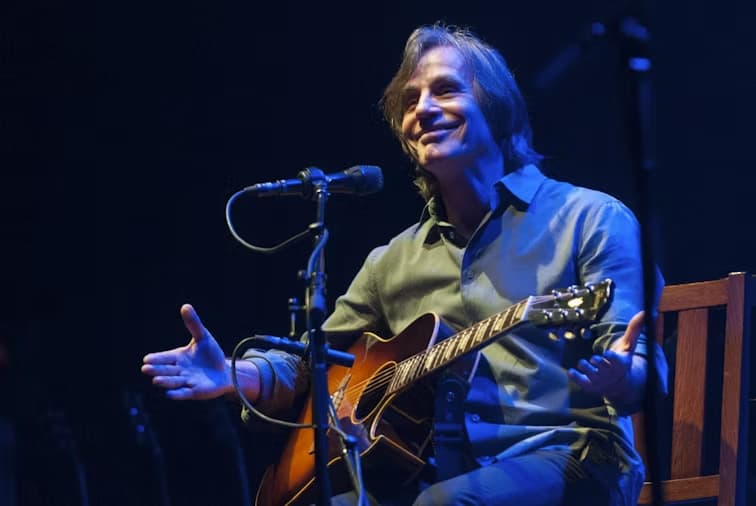
A quiet reckoning with time, love, and inevitability performed with startling emotional clarity
When Jackson Browne revisited “Late for the Sky” during his 2021 appearance on Austin City Limits, he returned not just to one of his defining songs, but to a piece that helped establish his artistry when it first appeared on the 1974 album Late for the Sky, which reached the Top 20 on the Billboard 200. Nearly five decades after its studio release, this performance was not an act of nostalgia. It felt like a continuation of the song’s journey, shaped by lived experience, the passing of decades and the quiet weight of hindsight. By the time the first guitar chords rang out on the ACL stage, the song no longer sounded like the reflection of a young poet searching for meaning. It sounded like a life examined.
Much of the enduring power of “Late for the Sky” lies in its intimacy. The lyrics face the unraveling of a relationship without bitterness or dramatic collapse. Instead, the song lingers in the in between space where realization arrives before departure, where silence replaces conversation and where love fades by degrees rather than by catastrophe. In the 2021 performance, Browne delivers these lines with a voice touched by age, yet smooth enough to retain his signature calm warmth. The delivery feels lived in rather than performed. He does not push emotion outward. Instead, he allows the audience to step into the song’s interior stillness.
Musically, the Austin City Limits performance respects the original arrangement but deepens it. The measured tempo, gentle chord progression and subtle harmonies create a reflective atmosphere. The musicianship is mature and unforced, demonstrating that restraint can be more powerful than grand gestures. Every instrumental line seems to serve the emotional gravity of the lyrics. Nothing feels ornamental. Nothing feels hurried.
What makes this performance particularly affecting is how the themes of the song resonate differently in the later chapter of Browne’s life. In 1974, it was a young man wrestling with the fragile boundaries between idealism and reality. In 2021, it becomes a meditation on what time teaches. The questions remain the same, but the voice asking them has changed.
Watching Browne sing it now feels like witnessing an artist in full conversation with his younger self. The longing is still there, but it is tempered by acceptance. The reflection is still sharp, but softened by compassion. The song has aged, not like something preserved but like something lived with.
In that setting, with the Austin City Limits stage offering both intimacy and reverence, “Late for the Sky” felt less like a performance and more like a quiet truth spoken aloud. It reminds listeners that heartbreak, memory and reflection can be just as powerful as any crescendo. Sometimes the most enduring songs are the ones that slow time long enough to let us feel what we once rushed past.