
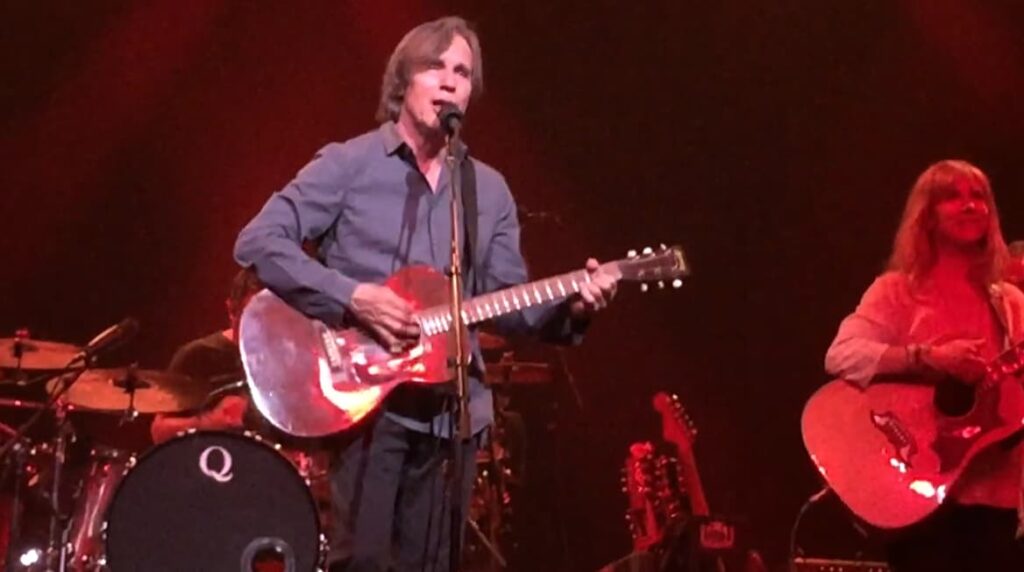
Front Row Reverence: Jackson Browne Revisits a 1976 Masterpiece in Birmingham
On October 14, 2015, at the historic Alabama Theatre in Birmingham, Jackson Browne delivered a performance that carried both musical weight and personal history. From a front row center vantage point, the evening captured Browne performing “Mama Couldn’t Be Persuaded,” a song written by his longtime friend and collaborator Warren Zevon. The choice of material was significant, rooted not in casual tribute but in shared artistic origins.
“Mama Couldn’t Be Persuaded” appears on Zevon’s 1976 self titled album Warren Zevon, his first major label release. That record marked a turning point in Zevon’s career after years of industry struggle. Crucially, it was produced by Browne himself, who played a decisive role in helping Zevon secure his contract with Asylum Records. Browne’s involvement went beyond standard production duties. He championed Zevon’s songwriting, assembled accomplished session musicians from the Southern California music community, and helped shape the sonic identity that would define Zevon’s early legacy.
By 2015, nearly four decades after that album’s release, Browne’s decision to revisit “Mama Couldn’t Be Persuaded” carried layered meaning. This was not simply a performance of a well known catalog piece. It was a return to a recording he had helped bring into existence. In doing so, Browne honored not only Zevon’s memory but also a formative chapter in both of their careers.
At the Alabama Theatre concert, Browne was joined by multi instrumentalist Larry Campbell and vocalist Teresa Williams. Campbell’s restrained guitar work and Williams’ harmonies added texture without overshadowing the narrative core of the song. The arrangement remained faithful to the spirit of the original 1976 recording while reflecting the maturity and subtlety that define Browne’s later live performances.
The venue itself contributed to the evening’s resonance. The Alabama Theatre, a restored 1920s movie palace, offers an intimate acoustic environment that allows nuanced songwriting to breathe. From the front row perspective, the interplay among the musicians was clearly visible, underscoring the collaborative ethos that has long characterized Browne’s concerts.
Zevon’s 1976 album established him as a writer capable of combining sharp character sketches with emotional complexity. Browne’s performance in Birmingham reaffirmed that legacy. By selecting a song from the very album he produced, Browne underscored the depth of their professional bond and the enduring respect he holds for Zevon’s craft.
For the audience present that night, the performance functioned as more than nostalgia. It was a living link to the mid 1970s singer songwriter movement, presented with clarity and sincerity. In Birmingham, history was not merely remembered. It was carefully and thoughtfully performed, one song at a time.