
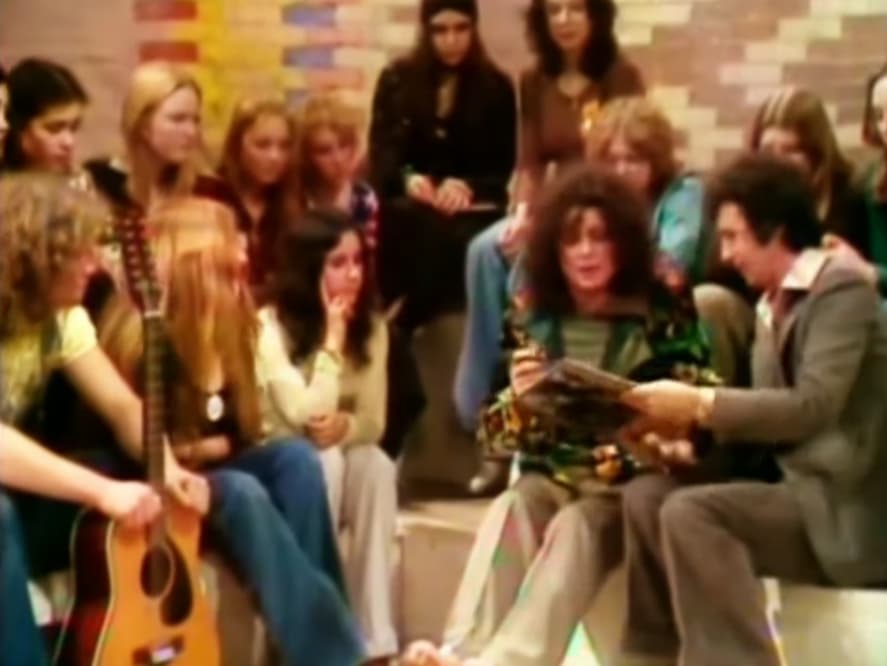
Marc Bolan on London Bridge 1975 and a Rare Glimpse of a Creative Mind at Work
The 1975 London Bridge interview with Marc Bolan stands today as one of the most revealing and quietly moving documents of his later career. Appearing relaxed, articulate, and unmistakably himself, Bolan offered viewers far more than promotional talk. He revealed a working artist in constant motion, driven by curiosity, discipline, and an almost childlike enthusiasm for creation.
Fresh from returning to London after an extended stay in America, Bolan spoke openly about recording new material and producing other artists. At a time when the press often questioned his visibility, he answered simply with work. He had been touring, recording, and preparing the follow up to Zip Gun, demonstrating that his creative momentum never truly slowed. There is a calm confidence in how he describes this period, not defensive, but focused, as if the noise around fame had become secondary to the act of making music.
One of the most striking moments comes when Bolan discusses songwriting. Asked to offer advice to aspiring composers, he strips the process down to its essentials. Learn the basic chords. Play them until they feel natural. Most importantly, keep playing. His words carry no mystique or false mythology. Songwriting, in his view, is not about waiting for inspiration but about commitment and perseverance. Even when he demonstrates musical ideas, it feels informal and immediate, as if creation is something that should happen in everyday space rather than sacred isolation.
When the conversation turns to lyrics, Bolan becomes unexpectedly grounded. He speaks about writing from the heart, acknowledging that it may sound corny but insisting it is true. He encourages reading poetry, observing the world, even drawing ideas from newspapers. This practical approach reveals a songwriter deeply engaged with both inner emotion and external reality, blending imagination with observation.
The interview also hints at Bolan’s expanding artistic ambitions. He mentions an upcoming film role in which he would play a psychotic murderer, a sharp contrast to his glam rock image. He also speaks of a new book and further recording plans, suggesting an artist eager to explore multiple forms of expression rather than remain confined to a single persona.
What makes this London Bridge appearance especially poignant is its tone. Bolan appears approachable, generous, and fully present. He listens, responds thoughtfully, and engages warmly with fans in the studio. There is no sense of retreat or disillusionment. Instead, there is a clear joy in being creative and in sharing that process with others.
Viewed today, this rare interview captures Marc Bolan not as a symbol of an era, but as a working artist committed to growth. It is a reminder that behind the glitter and myth was a musician who believed deeply in the simple power of playing, writing, and staying true to what he felt.