
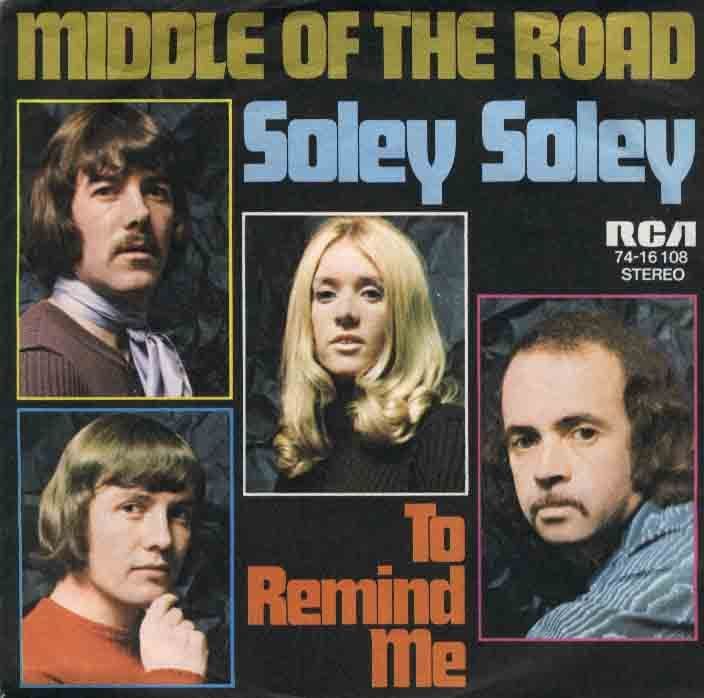
“Soley, Soley”: A Sun-Drenched European Breeze of Innocence and Longing
There are certain melodies that, regardless of the passage of decades, possess an uncanny ability to transport us back to a specific time and feeling. For many, particularly those who experienced the burgeoning sound of Europop in the early 1970s, Middle Of The Road’s “Soley, Soley” is precisely one such enchanting sonic postcard. Released in August 1971, this delightful track, with its bright harmonies and an irresistible sense of wistful sunshine, served as a gentle counterpoint to the heavier rock and more introspective folk dominating other corners of the music world. It wasn’t just a catchy tune; it was a fleeting dream, a hint of summer holidays, and a charming emblem of a simpler, more innocent era.
Upon its release, “Soley, Soley” proved to be a significant success across Europe, cementing Middle Of The Road’s reputation as a leading light in the emerging Europop scene. While their earlier smash “Chirpy Chirpy Cheep Cheep” had already conquered charts, “Soley, Soley” demonstrated the band’s continued appeal and versatility. In the UK, it reached a respectable number 5 on the Official Singles Chart in late 1971. However, its success was even more pronounced on the continent, where it soared to number 1 in countries like Belgium, the Netherlands, Norway, Sweden, and Switzerland, and also performed strongly in places like Germany, Austria, and even across Latin America. This widespread popularity underscored the song’s universal appeal, its ability to transcend language barriers with its sheer melodic charm. For those of us who remember those days, “Soley, Soley” was a constant companion on the radio, a welcome splash of vibrant color in a sometimes grey world.
The story behind “Soley, Soley” is rooted in the fertile creative exchange between British musicians and European songwriting talent. The song was written by Spanish musician Fernando Arbex, a notable figure in the Spanish rock scene, particularly known for his work with the band Los Brincos. Middle Of The Road, a Scottish band comprised of Sally Carr (vocals), Ian McCredie (guitar), Eric McCredie (bass), and Ken Andrew (drums), found their initial success after relocating to Italy, where they were discovered and signed. It was during their time abroad that they embraced a more pop-oriented sound, perfectly suited for the catchy, melodic compositions that would become their hallmark. When Arbex’s demo of “Soley, Soley” reached them, it was a natural fit for their distinctive sound, characterized by Sally Carr’s clear, sweet vocals and the band’s tight, harmonious arrangements. The song was recorded at RCA Studios in Madrid, further cementing its pan-European roots.
The meaning of “Soley, Soley” is imbued with a sense of longing and a yearning for light and warmth, even if the exact subject of that longing remains somewhat open to interpretation. The repeated phrase “Soley, Soley” itself, though sometimes misheard or seen as a proper name, is evocative of “soleil,” the French word for sun. It suggests a plea for brightness, for solace, or perhaps for a return to happier times. The lyrics, while simple, paint a picture of a journey, of searching for something lost or desired: “I’m looking for a place / Where the sun still shines.” This simple yet profound sentiment resonated deeply, particularly in times when the world often felt complex and uncertain. For older listeners, it evokes a powerful sense of nostalgia, transporting us back to those carefree moments, perhaps a summer holiday by the sea, or a feeling of simple contentment that seems harder to grasp with the passage of years.
The song’s arrangement, with its distinctive guitar riff, buoyant rhythm, and the ethereal quality of Carr’s vocals, creates an atmosphere of gentle melancholy intertwined with an undeniable optimism. It’s a song that makes you want to hum along, to sway, and to perhaps even close your eyes and recall a memory bathed in sunlight. “Soley, Soley” remains a testament to the enduring power of pure, unpretentious pop music to uplift the spirit and provide a comforting sense of warmth, a reminder that even when shadows fall, there’s always a possibility of finding the light again. It stands as a cherished piece of a bygone era, yet its tender charm continues to shine brightly today.