
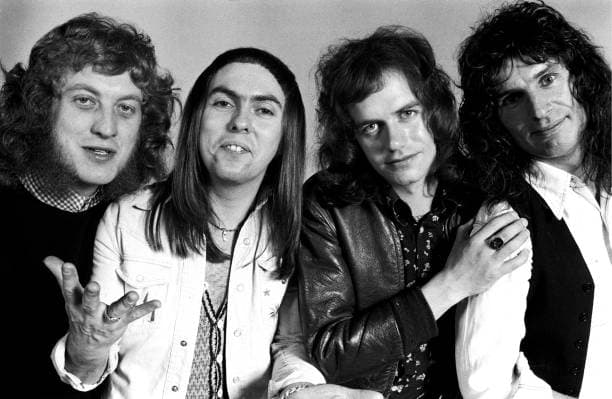
A rollicking B‑side swagger that underpins Slade’s working‑class bravado in full flight
The 1974 single Everyday by the British glam‑rock stalwarts Slade surged to No. 3 on the UK Singles Chart—marking another potent hit from their unstoppable early‑’70s run. Accompanying that A‑side was the energetic, gritty B‑side Good Time Gals, which while not charting on its own fell into the firm orbit of Slade’s catalogue as part of the album Old New Borrowed and Blue, released in February 1974.
In the macro‑narrative of Slade’s evolution, “Good Time Gals” plays a valuable role: it is not the melodic ballad that “Everyday” became, yet it encapsulates the band’s rough‑hewn charm—its working‑class energy, its sense of crowd‑pleasing drama, and its unapologetic rock attitude. Although “Good Time Gals” is seldom singled out for deep critical dissection, placing it in context allows us to appreciate how Slade deftly balanced melodic diversification and raw rock immediacy in this peak era.
Behind the scenes, “Old New Borrowed and Blue” marked a subtle pivot for Slade—they were, at this juncture, pushing beyond their barnstorming stadium‑ready anthems toward something with a touch more nuance, while still delivering the riotous stomp that defined their identity. On one side you have “Everyday,” the piano‑led reflection, and on the flip side “Good Time Gals,” the grit‑and‑grin rocker that nods to the band’s roots. That contrast is telling: Slade were demonstrating versatility without abandoning the chest‑thumping solidarity that their fans adored.
Lyrically and musically, “Good Time Gals” evokes the sense of being part of the crowd, of the night out, of voices raised together in defiance of dull routines and dim possibilities. The phrasing, the beat and the performance all suggest a band comfortable in its own skin—performing for the working‑class masses, for the bar‑room chorus, for the communal roar. While the record books may leave “Good Time Gals” somewhat in the shadows compared to the A‑side, the very existence of such a B‑side reflects the band’s commitment to giving value: a track that holds its own, that rounds out the single, that deepens the listening experience for those delving beyond the hit.
Emotionally, the song functions as a bridge—between the glamour of the glam rock stage and the grit of the everyday. It carries the implication that the “good time” is here, now, in the shared moment; it resists resignation, honours the communal spark, and affirms that Slade—and their audience—are here for more than quiet reflection: they’re here to shout together, to raise fists, to stomp in unison.
In the grander sweep of Slade’s legacy, “Good Time Gals” stands as one of those under‑the‑radar gems that enriches the story of a band whose every single was loaded with surprise, charisma and ear‑worm power. For the mature listener attuned to nuance, it’s a reminder that under the glitter and the moustaches, Slade were deeply rooted in communal rock & roll, working‑class euphoria, and no‑apology energy. So when you next spin the album or stumble across the 7″, let “Good Time Gals” roll: listen not just to the hit, but to the underside of the hit—the place where the crowd claps, the guitars crunch, and the night stretches ahead with promise.