
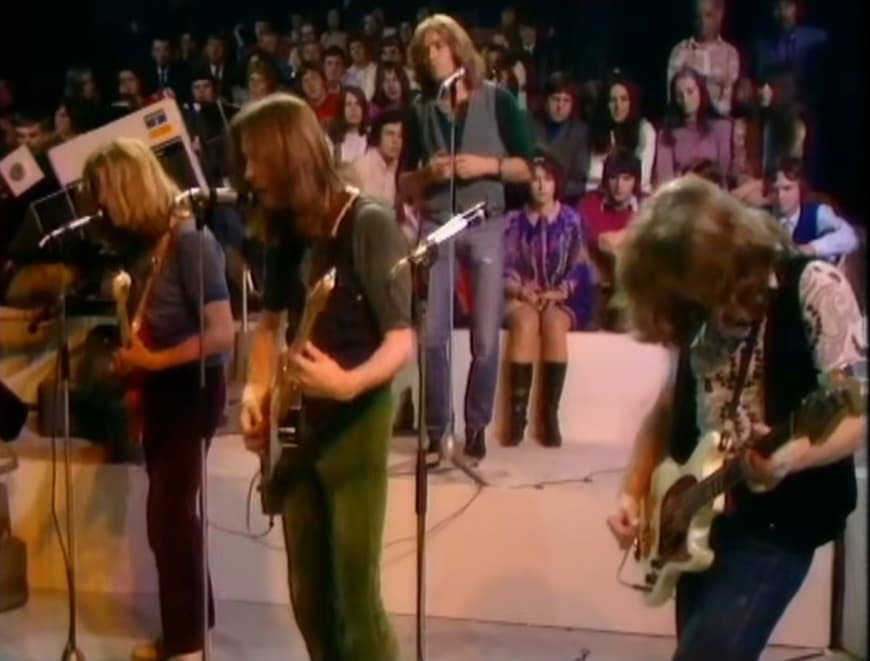
A bruising statement of intent as raw boogie rock finds its voice on live television
When Status Quo tore into “Down the Dustpipe” on Granada TV’s Doing Their Thing in 1970, the song was already making its mark as a pivotal turning point in the band’s career. Released earlier that year as a standalone single, “Down the Dustpipe” climbed into the UK Top 20, peaking just outside the Top 10, and soon became closely associated with the album Ma Kelly’s Greasy Spoon. For audiences watching at home, this live television performance captured a band in the act of transformation, shedding their psychedelic past and locking into the relentless, denim-clad boogie that would define them for decades.
By 1970, Status Quo were no longer content to be remembered for flowered shirts and whimsical pop singles. “Down the Dustpipe” announced a harder, grittier identity, built on repetition, volume, and physical momentum. On Doing Their Thing, that identity is unmistakable. Rick Parfitt and Francis Rossi stand shoulder to shoulder, guitars churning in tight unison, creating a sound that feels less like a song and more like a force. There is no ornamentation, no detour. The groove is the message.
Musically, the live performance strips the track to its bare essentials. The riff is blunt and circular, hammering itself into the listener’s consciousness with stubborn insistence. John Coghlan’s drumming is heavy and driving, giving the song its locomotive pull, while Alan Lancaster’s bass anchors the entire structure with a deep, rumbling presence. Rossi’s vocal delivery is urgent and rough-edged, less concerned with polish than with propulsion. This is rock music designed to move bodies, not impress critics.
Lyrically, “Down the Dustpipe” reflects a sense of frustration and confinement, emotions that resonated deeply with working-class British youth at the dawn of the 1970s. The imagery suggests being pushed aside, discarded, or forced into narrow paths by forces beyond one’s control. Yet in performance, especially in this televised setting, the song becomes an act of resistance. The repetition feels defiant, as if insisting on existence through sheer volume and persistence.
What makes this Doing Their Thing appearance especially significant is its timing. British television in 1970 was still a crucial gateway between bands and the public, and Status Quo used this platform not to soften their image but to double down on heaviness. The performance feels confrontational in its simplicity. No smiles, no theatrics, just the grind of amplified guitars and a rhythm that refuses to let go.
Looking back, this live rendition of “Down the Dustpipe” stands as an early declaration of the Quo philosophy. Rock music as endurance, as repetition, as communal physical experience. It marks the moment when Status Quo stopped chasing trends and began carving out their own lane, one built on sweat, volume, and unwavering commitment to the groove. In that sense, this 1970 television performance is not merely a historical curiosity. It is the sound of a band discovering exactly who they were meant to be.