
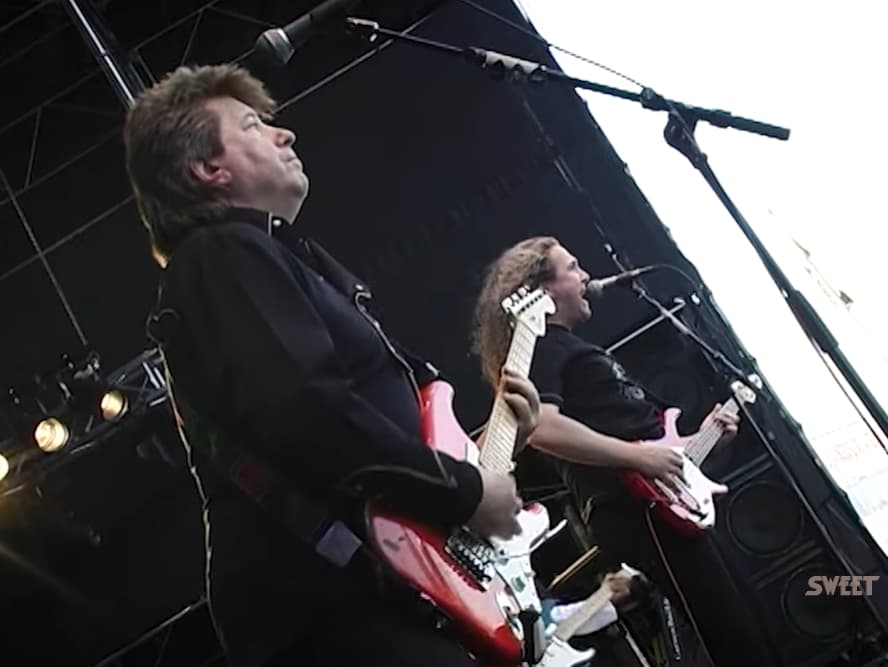
A thunderous revival of glam rock rebellion carried forward by grit, memory, and sheer stage fire
When Sweet took the stage at the Sweden Rock Festival in Norje Havsbad on June 10, 2006, their live performance of “Hell Raiser” stood as a powerful reaffirmation of the band’s enduring legacy. Originally released in 1973, “Hell Raiser” was a major UK hit, climbing to number two on the UK Singles Chart and cementing its place as one of Sweet’s defining anthems. More than three decades later, performed in front of a devoted festival crowd, the song proved that its defiant spirit and raw energy had lost none of their potency.
By 2006, Sweet were no longer the chart-dominating glam juggernaut of the early 1970s, but something arguably more compelling: a seasoned live band carrying the weight of history with pride and authority. At Sweden Rock, Tony O’Hora handled lead vocals and bass duties, delivering the song with muscular conviction and a grounded sense of command. Andy Scott, the last remaining member from Sweet’s classic lineup, anchored the performance on lead guitar and vocals, serving as both musical engine and living bridge to the band’s origins. Alongside them, Bruce Bisland on drums and vocals and Steve Grant on guitar, keyboards, and vocals completed a lineup focused not on nostalgia, but on power and cohesion.
Musically, “Hell Raiser” thrives in the live environment. Its stomping rhythm, massive chorus, and hard-edged guitar lines were always designed for the stage, and at Sweden Rock the song roared with renewed force. Andy Scott’s guitar work cut sharply through the mix, emphasizing the track’s blues-rooted crunch while retaining its glam swagger. The rhythm section drove the song forward with relentless momentum, transforming the open-air festival grounds into a communal surge of sound and movement.
Lyrically, “Hell Raiser” has always been a celebration of unruly freedom. It speaks to youth, rebellion, and the refusal to conform, themes that resonate across generations. In 2006, those words carried added weight. Sung by musicians who had lived through rock’s many transformations, the song no longer sounded like youthful provocation alone. Instead, it became a statement of endurance. To be a hell raiser, here, was not merely to defy authority, but to survive, to persist, and to keep the volume high despite time’s steady march.
The Sweden Rock performance underscores Sweet’s identity as a live band above all else. The polish of studio recordings gives way to grit, sweat, and direct connection with the audience. The crowd response feeds the band’s intensity, turning “Hell Raiser” into a shared ritual rather than a historical artifact. This is not a reenactment of past glory, but a living continuation of it.
Seen through the lens of history, “Hell Raiser” at Sweden Rock Festival 2006 stands as proof that glam rock’s heart still beats loudly when played with conviction. It reminds listeners that great rock songs do not belong to a single era. They endure because they speak to something elemental, the desire to be loud, unapologetic, and alive. In that moment on a Swedish summer night, Sweet did not look back. They raised hell all over again.