
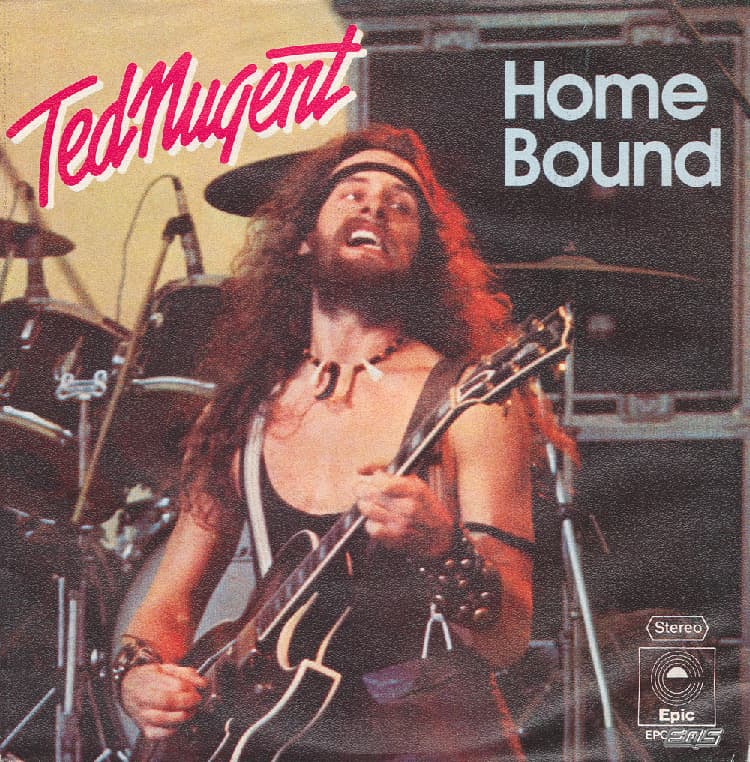
“Home Bound” is the unexpected, soulful instrumental journey on the wild ride of Cat Scratch Fever, representing a moment of poignant reflection amidst the usual hard rock frenzy.
There are some songs that don’t need a single lyric to tell a whole story, to stir up a tempest of memories and emotions that feel almost too personal to share. Ted Nugent’s “Home Bound,” a relatively understated instrumental track tucked into the fiery heart of his monumental 1977 album, Cat Scratch Fever, is precisely one of those pieces. For those of us who came of age in the tumultuous, electrifying 1970s, this song isn’t just music; it’s the sonic echo of a life spent on the road, the longing exhale after the roar of a thousand-watt stage. It’s a moment of profound, almost shocking, vulnerability from the Motor City Madman, a guitar legend whose public persona was, and remains, defined by a defiant, unbridled energy.
Released as his fifth single in January 1978, in the shadow of the colossal title track “Cat Scratch Fever,” “Home Bound” managed to carve out its own small but significant place on the charts. It peaked at Number 70 on the US Billboard Hot 100. While it may not boast the chart-busting numbers of its hard-rock brethren, that Hot 100 appearance is a testament to the track’s singular power. In an era where rock stations were blasting anthems and power chords, this instrumental—a melodic, almost spiritual departure—proved compelling enough to capture the ears of a broad audience. It was a fleeting, atmospheric moment on the radio dial that offered a deeper glimpse into the soul of the often-flamboyant guitarist.
The true meaning and story behind “Home Bound” are found not in liner notes, but in the yearning sound of Nugent’s guitar itself. For a man who lived and breathed the road—a relentless, touring machine, always chasing the next sold-out stadium—the concept of “home” must have held a deeply complex resonance. This track is the ultimate paradox of the road warrior: the desperate need for the primal scream of rock and roll countered by the soul-deep pull of domesticity, of familiarity, of simply stopping. It is the soundtrack to a late-night drive, the tour bus rumbling through an empty landscape after the deafening applause has faded, and the overwhelming thought that, somewhere out there, a quiet place is waiting.
The guitar work on “Home Bound” is nothing short of exquisite, showcasing a side of Ted Nugent’s musicianship often overshadowed by his more bombastic hits. It’s an “exquisite and surprisingly melodic instrumental,” as one critic aptly noted, that reveals his profound Delta Blues roots and his mastery of controlling feedback and pentatonics, turning mere noise into art. Listen to the way his riffs build, soar, and then gently resolve—it’s the sound of a man wrestling with the very nature of his life. It’s the journey from the electric chaos of the stage to the inner quiet of his own mind. For us, the listener, especially those who know the weight of years and the echoes of paths taken and not taken, this song evokes that deep, powerful nostalgia for a simpler time, a remembered sanctuary. It’s a reminder that even the wildest spirits need a tether, a place to return to, a port in the storm of life. The very title suggests a yearning, a physical and emotional trajectory toward sanctuary, making it a surprisingly poignant moment on an album otherwise dedicated to raw, unadulterated rock fury. It’s the tear in the leather jacket, the moment of soft focus in a landscape of blinding light.
This track is an integral piece of the Cat Scratch Fever legacy, not just for its beauty but for its influence, which stretches across generations. Its opening riff would later be famously sampled by the Beastie Boys and Biz Markie in “The Biz vs. the Nuge” on their 1992 album Check Your Head. This sampling is a quiet, yet powerful, validation of “Home Bound’s” inherent cool and foundational groove, proving that its soulful rhythm transcended genres and decades. It’s a track that stands as a melodic, powerful testament to the complexity lurking beneath the surface of the Motor City Madman.