
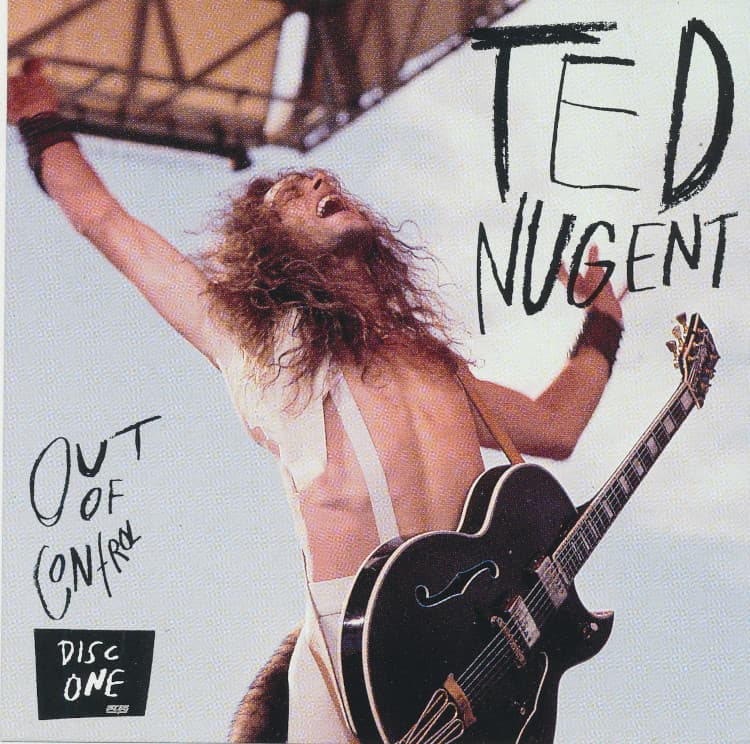
A Thunderous Cry of Wild Freedom and Untamed Energy
There are certain rock anthems that don’t just echo; they roar through the decades, capturing a specific moment in time with such raw, unbridled force that they become sonic landmarks. One such track, a furious gem from the golden age of American hard rock, is “Out of Control” by the incomparable guitar icon, Ted Nugent. Released in 1977 on his third, and arguably most potent, solo album, Cat Scratch Fever, this song wasn’t just a track; it was an adrenaline shot straight to the heart of a generation hungry for authentic, unapologetic rock and roll.
It’s a curious thing about rock history—sometimes, the most visceral, crowd-inciting tracks don’t always claim the top chart spots, though their cultural impact is infinitely greater. While the album itself, Cat Scratch Fever, was a commercial juggernaut, peaking at Number 17 on the US Billboard 200, and its title track became the massive Top 30 single we all remember, “Out of Control” itself was never released as a single and therefore didn’t have its own distinct chart position. Yet, for those of us who bought the album, who dropped the needle on the vinyl and felt that opening riff snake its way into our consciousness, this track was the album’s true, thumping pulse. It was the deep cut that became a personal anthem, the song that truly defined the “Nuge’s” live show for years to come.
<hr>
The story behind this track is steeped in the mythology of Ted Nugent himself—a man whose entire persona was built on a foundation of electric energy, primal urges, and a profound, almost spiritual, connection to the wilderness. The late 1970s was a period of both excess and introspection in rock music. Bands were either soaring into symphonic epics or diving into the nihilism of punk. Nugent, however, remained steadfastly “out of control” in his own domain: high-octane, riff-driven boogie rock. The song was a direct musical translation of his famously high-energy stage presence and his core philosophy: living life with an almost reckless abandon, embracing one’s wild side, and rejecting the shackles of societal norms. It was written during a time when Nugent was a touring force of nature, perpetually on the road, pouring every ounce of his relentless energy into every performance. The song’s intensity is not manufactured; it is a genuine overflow of the sheer, exhausting exhilaration of his life as a rock star.
<hr>
What, then, is the profound meaning of a track titled “Out of Control”? It is far more than a simple ode to chaos. It’s an electrifying declaration of autonomy. The lyrics paint a picture of someone pushed to their limit, someone who has finally snapped the restraints and is hurtling forward on their own terms, fueled by an internal, insatiable fire. When Nugent screams, “Out of control, I’m out of control,” it’s not a lament; it’s a triumph. It’s the sound of liberation. For the older fan, the one who navigated the rigid expectations of the 60s and 70s, this song was a sonic permission slip—a three-and-a-half-minute rebellion against the mundane.
The powerful imagery—“I feel the devil risin’ up within my soul”—isn’t about literal evil; it’s about the untamed, powerful beast that lies within all of us, the instinctual self that society constantly tries to suppress. The song means embracing that magnificent, terrifying internal force. It’s the moment you decide to quit the job, take the risk, or simply drive too fast with the windows down, feeling utterly, gloriously alive. It taps into the deep, yearning human desire to shed responsibility, if only for a fleeting, powerful moment. In a world that constantly demands conformity, “Out of Control” remains a timeless, deafening reminder that sometimes, the only way to truly find yourself is to let go entirely and embrace the beautiful, dangerous chaos of being human. It is, ultimately, a masterpiece of rock and roll existentialism, delivered with a snarl and a six-string shriek that will never fade.