
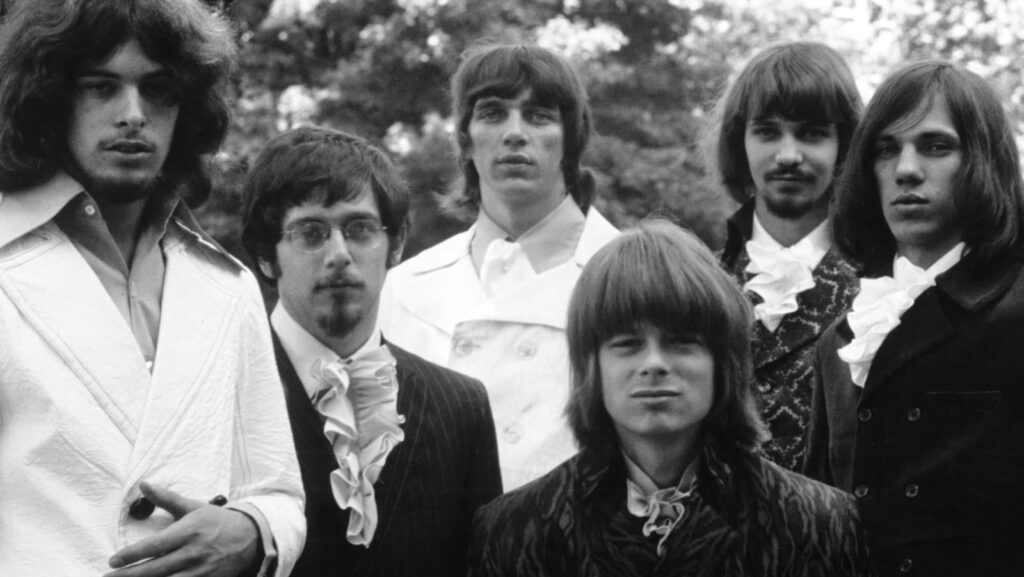
A psychedelic plunge into altered consciousness shaped by contradiction, rebellion, and electric force
Released in 1968, “Journey To The Center Of The Mind” by Amboy Dukes rose to number 16 on the US Billboard Hot 100, securing its place as one of the most potent and enduring statements of the American psychedelic era. The song appeared on the band’s second album, Journey To The Center Of The Mind, a record that captured the volatile spirit of the late sixties, when youth culture, experimentation, and confrontation with authority collided at full volume. This single remains the defining moment of Amboy Dukes’ career, and the track through which many listeners first encountered the explosive guitar presence of Ted Nugent.
What gives “Journey To The Center Of The Mind” its lasting power is not merely its psychedelic imagery, but the tension at its core. Often labeled a drug anthem, the song is better understood as an inward exploration, a call to abandon rigid thinking and confront the unknown spaces of the mind. Yet embedded within it is one of rock history’s most fascinating contradictions. While the lyrics evoke altered states and expanded consciousness, Ted Nugent himself has long identified as strictly straight edge, openly rejecting drugs and alcohol. This apparent paradox is not accidental. The lyrics were written by Steve Farmer, the band’s second guitarist and vocalist, while Nugent focused entirely on the music, shaping the track’s relentless riffs and ferocious sonic attack.
That division of roles is essential to the song’s character. Farmer’s words invite surrender, curiosity, and mental escape, while Nugent’s guitar does not drift or dissolve. It charges forward with force, urgency, and confrontation. The result is a song that feels both hallucinatory and aggressive, introspective yet physically overpowering. The guitar tone snarls and surges, refusing softness or ambiguity, while the rhythm section locks into a driving pulse that feels almost militaristic in its intensity. This collision of lyrical suggestion and musical discipline is what gives the song its sharp edge and uncompromising presence.
Culturally, “Journey To The Center Of The Mind” arrived at a moment when psychedelic music was becoming increasingly ornate and dreamy. Amboy Dukes went in the opposite direction. Their sound was raw, loud, and confrontational, closer to garage rock than to the ornate psychedelia of the West Coast. This made the song stand out on radio and in the cultural conversation. It did not invite passive listening. It demanded engagement, movement, and reaction.
In hindsight, the song represents a brief but powerful convergence of opposing forces. It is the sound of lyrical exploration meeting musical defiance, of mental liberation framed by brute electric power. That contradiction is precisely why the song still resonates. It captures a moment when rock music did not need to resolve its internal conflicts to be truthful. It only needed to be honest in its intensity.
For Amboy Dukes, “Journey To The Center Of The Mind” remains a singular achievement. It stands as a document of a band, a generation, and a cultural moment unafraid to stare into the unknown, even when its creators themselves stood on opposite sides of the experience they were describing.