
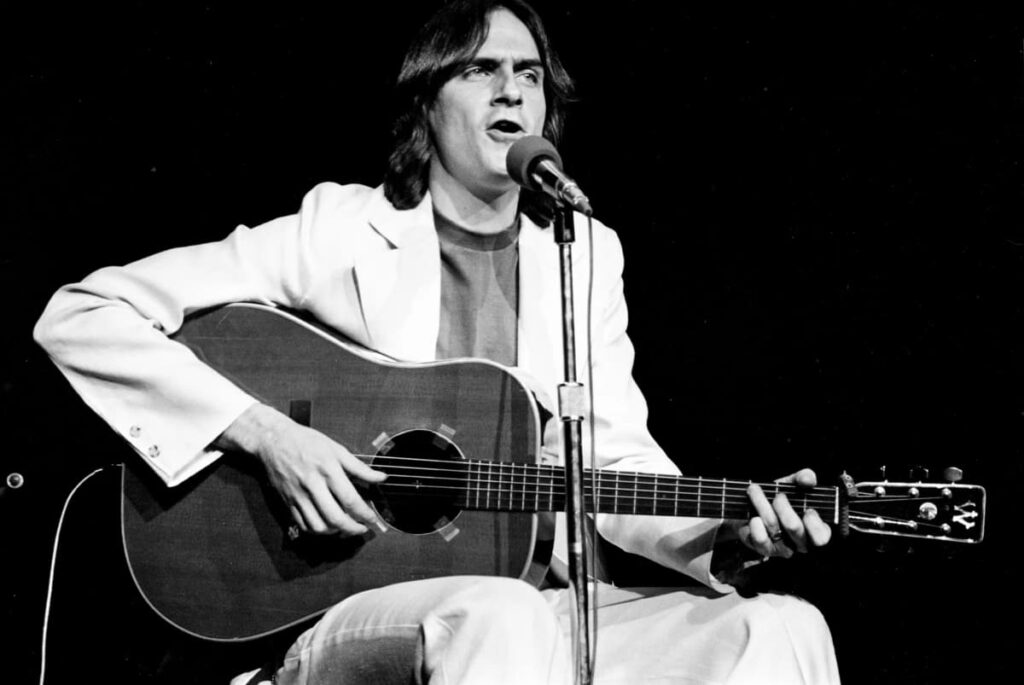
The Perpetual Traveler’s Lament: A Poignant Reflection on the Inescapable Urge to Wander and the Sacrifice of Connection.
The mid-1970s was an era when the earnest, soul-baring intimacy of the singer-songwriter held a sacred place in the musical landscape. Yet, even among his celebrated peers, James Taylor stood apart, his voice a balm of gentle melancholy and profound introspection. His 1974 album, the understated but deeply felt Walking Man, is a masterpiece of this period, and its title track, “Walking Man,” is perhaps the most personal and revealing drama of his lifelong relationship with restlessness.
Key Information: “Walking Man” is the title track and second single from James Taylor’s fifth studio album, Walking Man, released in June 1974. The song itself was not a major pop crossover, failing to reach the Billboard Hot 100, but it did find a comfortable home with its core audience, peaking at No. 26 on the Billboard Easy Listening chart in October 1974. The album, however, marked a commercial dip for the artist, reaching No. 13 on the US Billboard 200 chart and becoming the only studio album of his career (until 2008’s Covers) not to achieve Gold or Platinum certification. Despite its modest chart performance, the song remains a beloved staple and a telling piece of Taylor’s confessional canon.
The story behind “Walking Man” is a raw, dramatic chapter in James Taylor’s ongoing narrative of emotional turbulence. The year 1974 was a complex period for Taylor, one marked by immense celebrity but also personal struggle following the success of albums like Sweet Baby James and Mud Slide Slim. The album was recorded in New York City with producer David Spinozza, marking a temporary separation from his longtime collaborator Peter Asher. More significantly, the song’s creation coincided with a time of deep self-examination. Lyrically, Taylor channels an almost mythical figure, a man defined by forward momentum and an inability to linger. The song is often interpreted as Taylor’s self-portrait—a man always moving in silent desperation, always seeking a hypothetical destination. For those of us who followed his career closely, the image of the “walking man” felt like a thinly veiled confession, a dramatic admission that the domestic bliss he was trying to build (he was then married to Carly Simon) was constantly challenged by the siren call of the open road, the addiction to movement that his life as a touring musician required.
The meaning of “Walking Man” is a poignant meditation on the nature of the artistic life—a life often predicated on separation. It speaks to the burden of the traveler who is “always missing, / And something is never quite right.” The protagonist is contrasted with “any other man” who “stops and talks,” highlighting the walking man’s unique isolation. It’s a beautifully painful lament for the things sacrificed for the sake of the journey: stability, deep roots, and easy conversation. Taylor uses evocative, almost pastoral imagery—“the leaves have come to turning / And the goose has gone to fly”—to set his restless spirit against the comforting cycle of nature. When he sings the final, heartbreaking wish, “Would he have wings to fly? / Would he be free?” we understand that the “walking man” is not merely enjoying a stroll; he is desperately chasing an unattainable freedom, a liberation from his own restless soul. For older readers, the song evokes a deep, familiar nostalgia: the memory of roads not taken, of the yearnings that pulled us away from home, and the silent realization that sometimes, the only way to move forward is to leave a piece of yourself behind. “Walking Man” is James Taylor at his most brutally honest, reminding us that even the gentlest music can hold the sharpest truths.