
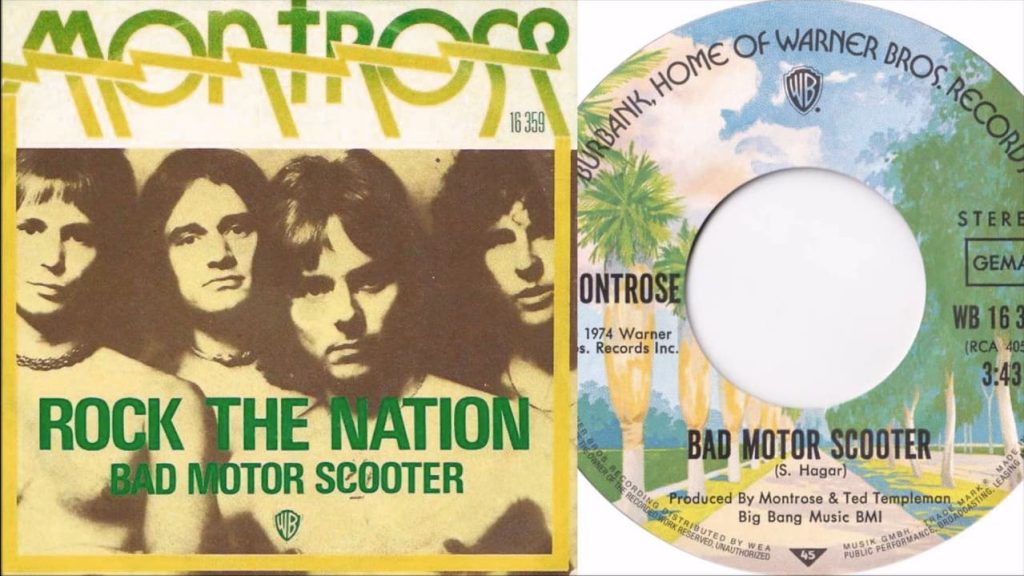
A roaring ride into rock-freedom and unbridled swagger
When the explosive chords of Bad Motor Scooter kick in, you’re launched into the full-throttle debut of Montrose—a band whose first album, Montrose, landed in October 1973. Penned by rising frontman Sammy Hagar, the track established itself as the standout from the set, even as the album peaked at only No. 133 on the U.S. Billboard 200. Though “Bad Motor Scooter” did not blaze chart-legend status in its day, it became a defining anthem in the hard-rock canon, its engine-revving opening a signature moment in rock’s transition toward more muscular territory.
From its very opening slide-guitar roar—an unmistakable simulation of a rumbling engine—the song declares itself not simply a track but a motion: forward, fast, reckless, yet joyous. Hagar’s vocals cut through the fuzz-box attack of guitarist Ronnie Montrose with a mix of brash confidence and youthful hunger. The arrangement places no artifice between player and purpose; it’s raw, immediate, and full of combustible energy. The riff powers on, taut and unpretentious, delivering the feel of asphalt under rubber, the hunger for movement, escape, and the pure thrill of rock. As one commentator puts it, “Bad Motor Scooter only has four chords, all major; it takes about two minutes to get out of first gear.”
In the broader narrative of the early 1970s, Montrose stood at the crossroads. Ronnie Montrose, having previously lent his guitar work to artists such as Edgar Winter, now struck out with a band that would galvanize the American hard-rock blueprint. “Bad Motor Scooter” exemplifies that: a fierce hybrid of blues-grounded rock, the swagger of West Coast cool, and an in-your-face fuzz tone that foreshadows the heavier riffs to come.
Lyrically, while not expansive in narrative ambition, the song captures a singular moment: the open road as metaphor for freedom, the machine (that “bad motor scooter”) as companion to the restless spirit, and the dare to break loose from the mundane. Hagar’s voice doesn’t linger on reflection—he accelerates. And in doing so, the track becomes less about story and more about sensation: the throttle twist, the engine’s wail, the wind in your face, the unknown ahead.
Musically, the intro’s slide/fuzz blur—credited to Ronnie Montrose’s experimentation in open-D tuning and a Big Muff fuzz box—was the spark that the band and producer Ted Templeman recognized as the missing hook. As the band found in the studio: “When the song was conceived before this guitar sound, the band and producer… were not happy because they felt it was missing a hook to make it stand out. Ronnie Montrose stumbled upon it while messing with a slide and fuzz box one day in the studio.” That moment of invention—of turning guitar feedback and slide work into a motorcycle engine’s voice—is the kind of lightning-in-a-jar moment that defines classics.
Over time, “Bad Motor Scooter” has worn many hats: a fan-favourite live piece (the band featured it on shows like The Midnight Special in 1975). It has also become a blueprint for how a band can fuse muscular guitar attack with a singer’s swagger and still keep a sense of fun at the core. It never sounds locked-in or over-calculated—despite the effect-pedal bravado, the song breathes with looseness, like a late-night joyride.
For the mature listener who remembers when rock sounded like it might break your speaker cone, “Bad Motor Scooter” is a pure rush. It invites you to hop on, rev the engine, and ride out of convention. Its legacy lies not in chart numbers but in the lasting image: a guitar as motorcycle, a singer as rider, and the road unrolling ahead. In that sense, this track remains timeless—a feral moment frozen in vinyl, still ready to peel out.
 Oldies Songs